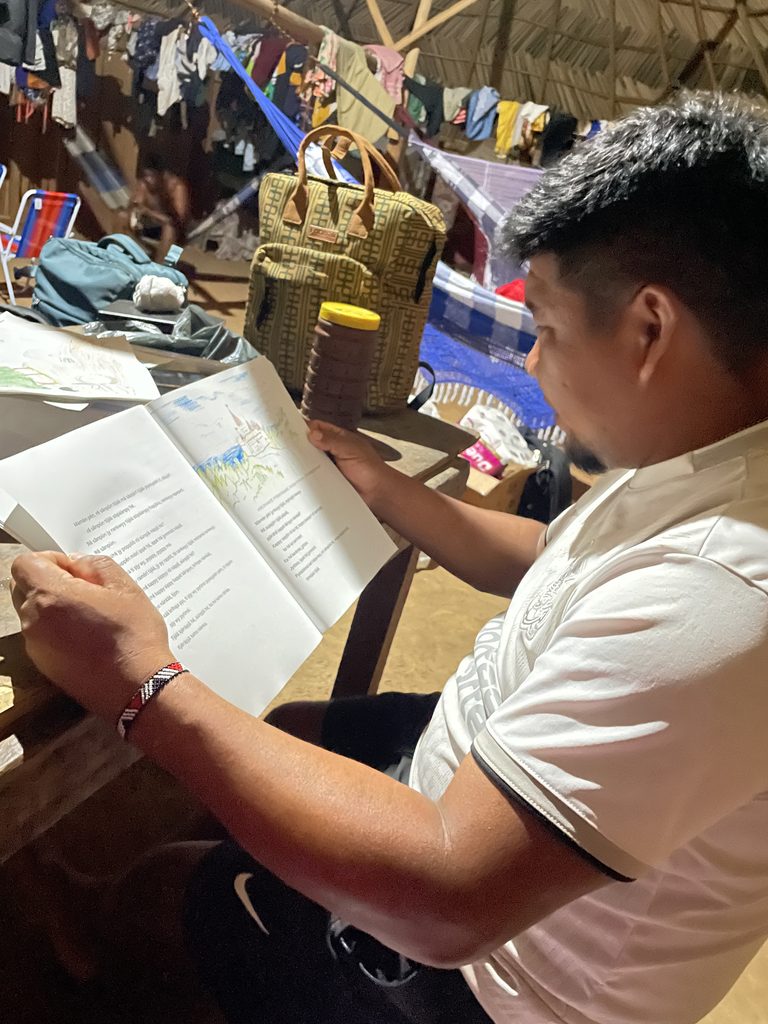
Myriam Lapierre and UW graduate students Sunny Ananthanarayan and Jessa Jeter spent four weeks conducting fieldwork with the Panãra community in Brazil this summer. Working with their friend and collaborator Tepakriti, they recorded numerous traditional narratives told by Panãra elders, transcribed several of these stories, recorded daylong recordings of infant language environments, conducted elicitation sessions, and collected data for a phonetics experiment on contrastive focus. They also delivered four illustrated books in Panãra to each of the schools in the various Panãra villages and conducted a three-day literacy workshop—the first ever held in the village of Sõnkârasãn. And last but not least, they watched the FIFA World Cup final!
Ziru Chen (she/her) is interested in phonetics and laboratory phonology, particularly topics in speech production and perception. She is from Zhejiang, China. She received her B.A. in Chinese Language and Literature from Peking University and her MSc in Phonetics from the University of Edinburgh. Her research has been focused on the variation and change in multidimensional contrasts in Wu Chinese. In her free time, she enjoys cooking, playing the piano, swimming, and wandering around the city she lives in.
Ryan Chon is interested in the intersections between phonological typology, sociolinguistic history, and Indigenous studies. His current research investigates both synchronic and diachronic phonology in Naduhup and Saami languages, but also has experience in Papuan and Romance linguistics from his time at Boston University, where he received his BA/MA. He is transferring to McGill after two years in the PhD program at the University of Washington. In his free time, he likes making and listening to music, cooking, reading, and being in nature.
Natalia Feu (she/her) is passionate about phonology, and particularly, analyzing the syllable structure of languages that seem to flout established phonotactic constraints. She has worked primarily with Lushootseed, a Coast Salish language. She is from Seattle, Washington and completed her B.A. Honours in Linguistics, with minors in Anthropology and Environment, at McGill University. In her spare time, she enjoys climbing (including human tower building), reading, and working on her ASL.
Bess Frerichs is interested in psycholinguistics, disfluency, and speech breathing. She completed her B.A. in Linguistics at the University of Oregon, where she wrote an honors thesis on the relationship between planning scope and the distribution of filled pauses (e.g., uh and um) in spontaneous speech. Bess enjoys hiking, playing video games (especially the Legend of Zelda series), and exploring museums and zoos.
Ilya Gritsenko specializes in experimental syntax and variation in language, especially in processes of agreement, mostly working with subject-verb agreement in Russian. Additionally, they have an interest in Jewish languages, especially underdocumented modern Hasidic varieties of Yiddish. Their B.A. in Linguistics was completed at Moscow State University. In their free time, Ilya enjoys studying philosophy and politics, cooking (and especially baking!) for groups of people, competing in shooting sports, photography, and creating 3D animations for obscure indie video games.
Baran Günay Baran Günay (he/him) is primarily interested in morpho-syntax and fieldwork, especially agreement. His work so far has focused on conjunct agreement in Hamshentsnag, an endangered Armenian variety spoken in Turkey. He completed his B.A. in English Translation and Interpreting at İstanbul Aydın University, and his M.A. in Linguistics at Boğaziçi University. Outside of linguistics, he plays electric guitar and writes music somewhere in tech/prog death metal territory. He also follows motorsports, plays tactical shooter games, and has never quite gotten over Minecraft.
Lishan Li is from Guangdong, China. She received her bachelor’s degree from Shandong University and her master’s degree from Beijing Normal University. Her research interests are mainly in phonetics, with a particular focus on speech perception, speech production, phonetic variation, and sound change. Outside of linguistics, she enjoys spending time with animals and taking care of plants.
Nagihan Lüle completed her BSc in Mathematics and recently finished her MA in Linguistics, both at Boğaziçi University. She is primarily interested in syntax and semantics; specifically, her work so far has focused on ellipsis and null arguments in Turkish. Outside of linguistics, Nagihan enjoys solving Sudoku, watching films, and discovering new places.
Franklin Ma (he/him) is interested in using linguistic theory to improve language and speech technologies, particularly by investigating how statistical models can acquire linguistic capabilities more efficiently from limited data, especially for dialects and low-resource languages. He received his BA in Computer Science and Cognitive Systems, Emphasis in Language, from the University of British Columbia, and completed a year-long exchange at the University of Tokyo. In his free time, he enjoys going out on walks, exploring new restaurants, and learning languages.
Anna Westwig (she/her) was raised in Ithaca, NY, USA with two older brothers, a variable number of chickens, and a pun-ishing amount of word play. She has B.A.s from Wellesley College (’25) for Classical Civilization and Cognitive Science, where she fell in love with playing the carillon, flute, and psycholinguistics. She spent a year abroad at Oxford and was surprised to learn they made the children do the accent, too! After graduating, she took a Fulbright to teach English in Tbilisi, Georgia, where she did a lot of inadvisable hitchhiking, courted vehicular manslaughter, and became obsessed with the uvular ejective. Her interests include speech perception/processing, individual difference in language use, sound change, and the ad-hoc onomatopoeias people produce when describing birdsong.
Emma Wrenn is particularly interested in phonetic documentation, especially of Mesoamerican languages, and in secondary articulations such as labialization. She has worked with P’urhepecha (isolate; Michoacán, Mexico) and San Juan Quiahije Chatino (Otomanguean; Oaxaca, Mexico) in the past and hopes to continue her work on Chatino languages in the future. She completed her B.A. and M.A. in Linguistics at the University of North Carolina at Chapel Hill (United States). Outside of linguistics, Emma enjoys crocheting, Dungeons and Dragons, and playing various wind instruments, especially in historical performance ensembles.
Shun Yamazaki is primarily interested in theoretical syntax and its interface with phonology and morphology. His interest mainly lies in Japanese syntax and its interfaces but he is also intereted in studying other languages. He is from Japan and completed his M.A. in Linguistics at Sophia University in Tokyo. Outside of linguistics, he enjoys hiking, playing with dogs, and watching sitcoms.
We may have one addition in the fall, to be confirmed.
As always, talks will take place Fridays from 3:30–5:00, with talk details announced before the talk. If you have any questions, you can reach out to this year’s new colloquium team: Hannah and Tony (student organizers) and Jessica (faculty organizer).
Willie Myers and Brandon Chaperon (MA ’25) both have papers published in the new volume ‘Pamoja tena’ Together again: African linguistics after COVID, a volume including select presentations from the 54th Annual Conference on African Linguistics, held at University of Connecticut in June 2024.
Willie Myers – Headless relative clauses and anti-agreement in Kirundi
Brandon Chaperon – A negative alternation: Negation head movement allomorphy in Igala
McGill Linguistics affiliates partnered with the grassroots Kanien’kéha language group Ionkwahrhonkha’onhátie’ to present three workshops in Akwesasne this summer. The first was on how to use linguistic elicitation as a second-language learner, the second was on transcribing language recordings with ELAN, and the third was on practices of archiving and Indigenous knowledge management. This workshop series was supported in part by a SSHRC Partnership Development Grant (PI Jessica Coon), as well as McGill’s Faculty of Arts Institute for Indigenous Research and Knowledges.
A number of McGillians took part in organizing the workshops, including Noelani Arista (Institute for Indigenous Research and Knowledges), Arihwí:saks Colin Benedict (MA Indigenous Language Revitalization ’26) Jessica Coon, Terrance Gatchalian (PhD ’25), Sarah Jacobs (BA ’26), Austin Kraft, Mary Onwá:ri Tekahawáhkwen McDonald (PhD Indigenous Language Revitalization ’26), Katya Morgunova (PhD ’26), Caleb Moses (Computer Science), Willie Myers, Zoe Regnier (Information Studies), and Sam Prins (new McGill post-doc).
June 24-29, LabPhon 20 was held in Montreal for the conference’s 40th anniversary, organized by McGill Linguistics members and colleagues in Ottawa. More than 300 people from around the world attended, including many current and former McGillians.
From L to R, Top row: Charlotte Pieper, Alex Zhai, Irene Smith, Alessio Tosolini, Scarlet Li Middle row: James Tanner, Yue Qiu, Kuilin Li, Massimo Lipari, Hazel Grover, Yuki MacDougall, Kie Zuraw, Julia Lusby, Ray Cox-Casals Front row: Meghan Clayards, Myriam Lapierre, Tony Juntao Hu, Jeanne Brown, Wei Zhang, Josh Lee
Sam’s research combines morphosyntactic theory, documentation, and (re)vitalization. Her theoretical work centers on formal models of inflection, agreement, and reference-tracking in Algonquian languages, particularly Blackfoot. Her documentary work focuses on Mayan languages, including Kaqchikel and Highland Mayan Sign Language. Her applied work involves collaborative language research, resource development, capacity-building, and organizing with community language workers in (re)vitalization contexts. Sam completed her PhD in linguistics at the University of Arizona. Her dissertation, supervised by Heidi Harley, explores inflectional syncretism in Algonquian languages, and the intersections of grammatical analysis with Indigenous language pedagogy. At McGill, she’ll join Jessica Coon in researching animacy and hierarchy effects in Haudenosaunee and Algonquian languages and developing reciprocal approaches to language work through community-university partnerships.McLing is happy to welcome Samantha Prins, joining us in September as a postdoctoral fellow working with Jessica Coon.
Sam’s research combines morphosyntactic theory, documentation, and (re)vitalization. Her theoretical work centers on formal models of inflection, agreement, and reference-tracking in Algonquian languages, particularly Blackfoot. Her documentary work focuses on Mayan languages, including Kaqchikel and Highland Mayan Sign Language. Her applied work involves collaborative language research, resource development, capacity-building, and organizing with community language workers in (re)vitalization contexts. Sam completed her PhD in linguistics at the University of Arizona. Her dissertation, supervised by Heidi Harley, explores inflectional syncretism in Algonquian languages, and the intersections of grammatical analysis with Indigenous language pedagogy. At McGill, she’ll join Jessica Coon in researching animacy and hierarchy effects in Haudenosaunee and Algonquian languages and developing reciprocal approaches to language work through community-university partnerships.
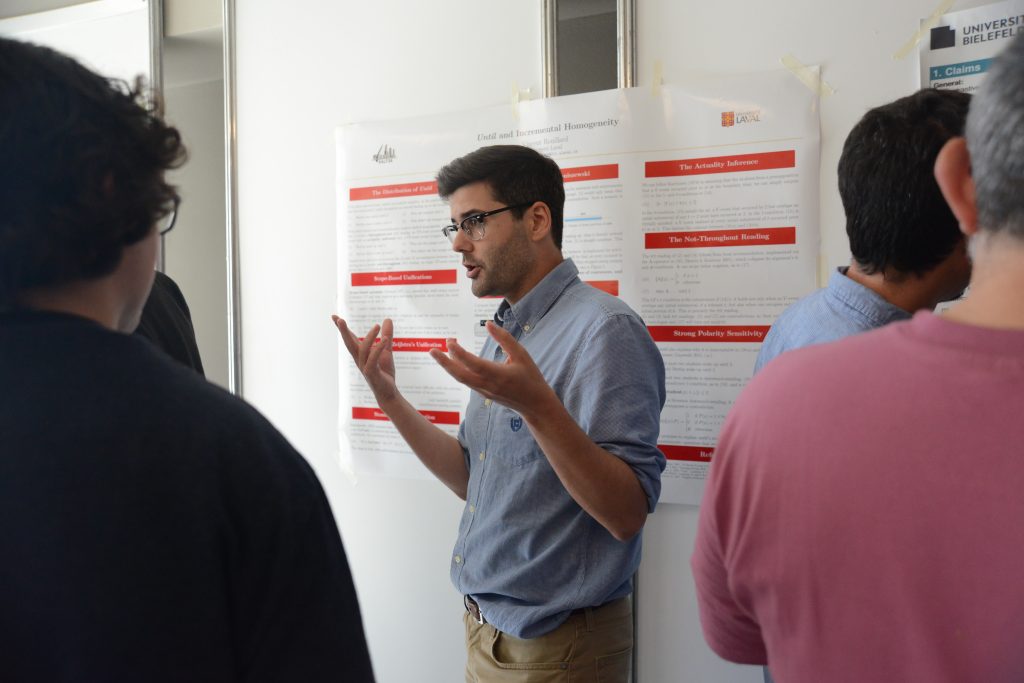
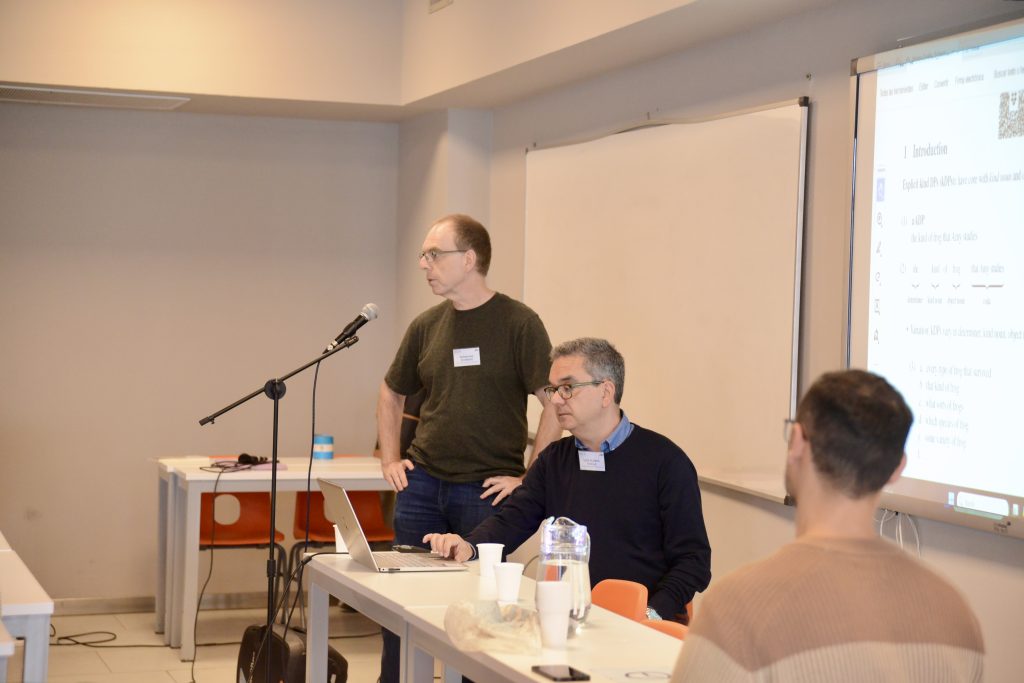
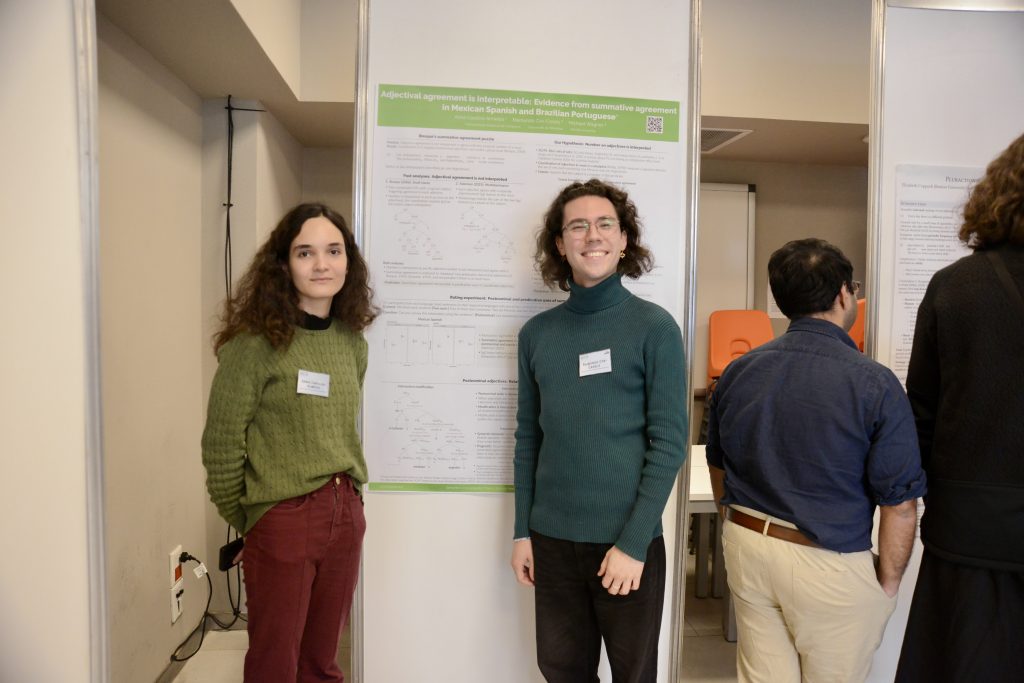
Several current and former McGill affiliates travelled to Argentina for Semantics and Linguistic Theory (SALT) 36, held July 29-31 at the University of Buenos Aires (https://saltconf.github.io/salt36/). Talks by current and former McGill affiliates included:
Anna Carolina Almeida, Raimundo Cox-Casals, and Michael Wagner: Adjectival agreement is interpretable: Evidence from summative agreement in Mexican Spanish and Brazilian Portuguese
Vincent Rouillard (BA 2017): “Until” and incremental homogeneity
Luis Alonso Ovalle and Bernhard Schwarz: Evidence for Wilkinson’s approach to “kind”-DPs