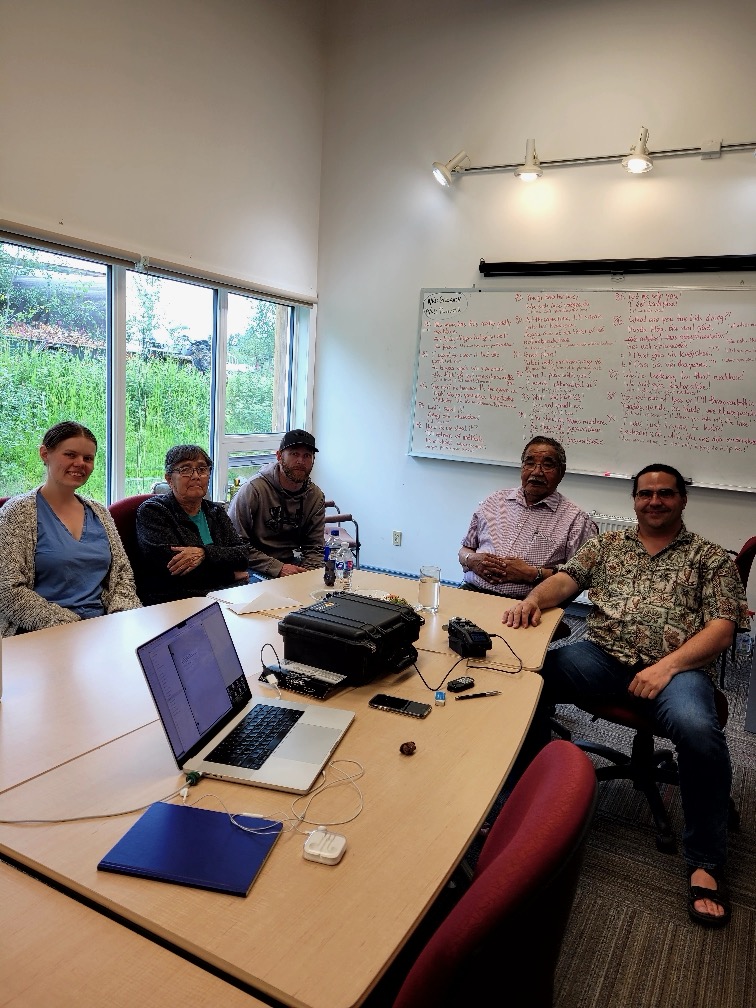
PhD student Laurestine Bradford and Dzéiwsh James Crippen travelled to Teslin, Yukon (Tlingit: Deisleen [tèːslìːn]) for two weeks in July. They worked with fluent Tlingit speakers Sam Johnston and Margaret Bob on Tlingit verb semantics. The elicitation sessions focused on event culmination, perfective and imperfective aspect, and pluractionality. The trip was supported by a McGill Graduate Mobility Award and a Jacobs Research Fund grant.
Teslin group photo
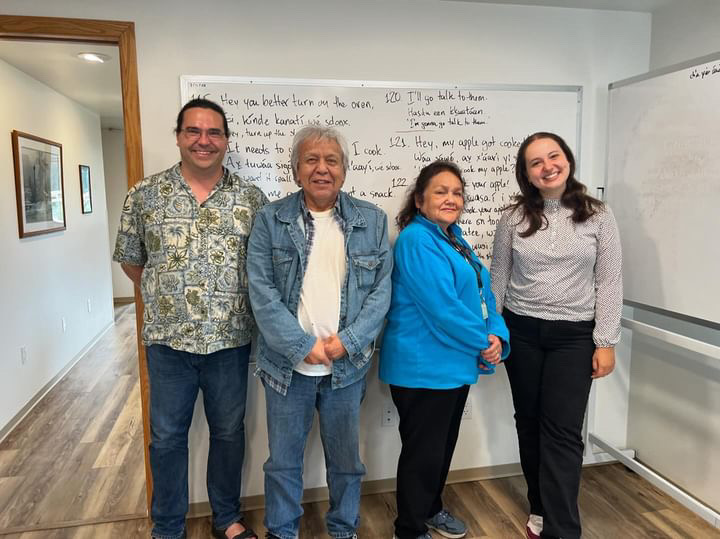
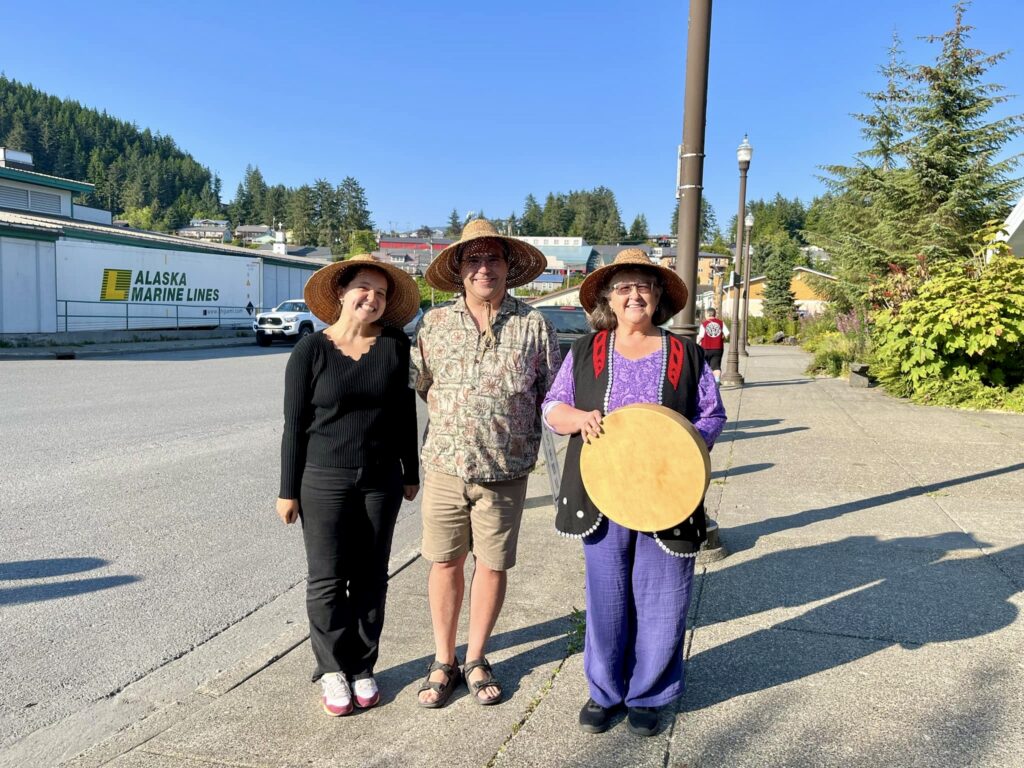
MA student Zlata Odribets spent two weeks in Wrangell, Alaska conducting fieldwork on Tlingit with Dzéiwsh James Crippen. They investigated the occurrence of the d– prefix in Tlingit passives, antipassives, and middles. Their work has also resulted in the creation of language materials that can be used by Tlingit language learners going forward.
Dzéiwsh, Tlingit language consultant Khudaxhghaaháa Ben Jackson, Tlingit learner Xwanlein Virginia Oliver, and ZlataZlata, James, and Tlingit Elder Ts’ootsxan Tlaa Sandy Churchill
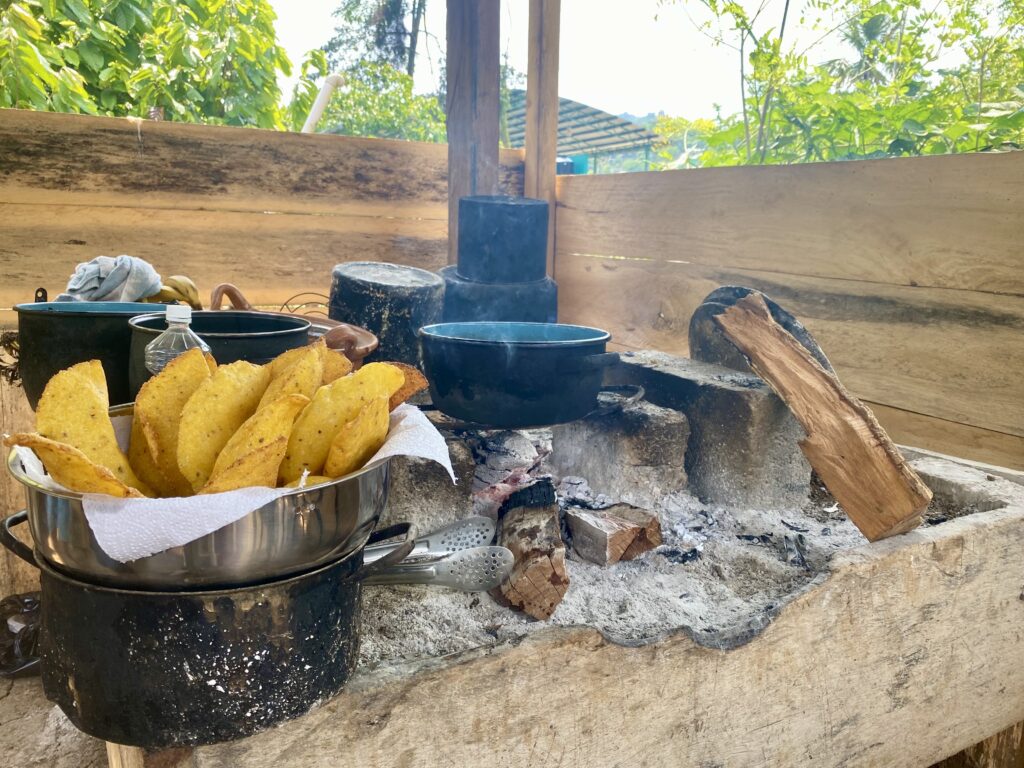
Jessica Coon spent two weeks in Chiapas, Mexico working on clausal pied-piping and animacy restrictions in Ch’ol with collaborator Juan Jesús Vázquez Álvarez (CIMSUR-UNAM).
Jessica grinding corn with Ch’ol consultant, Virginia Martínezempanadas
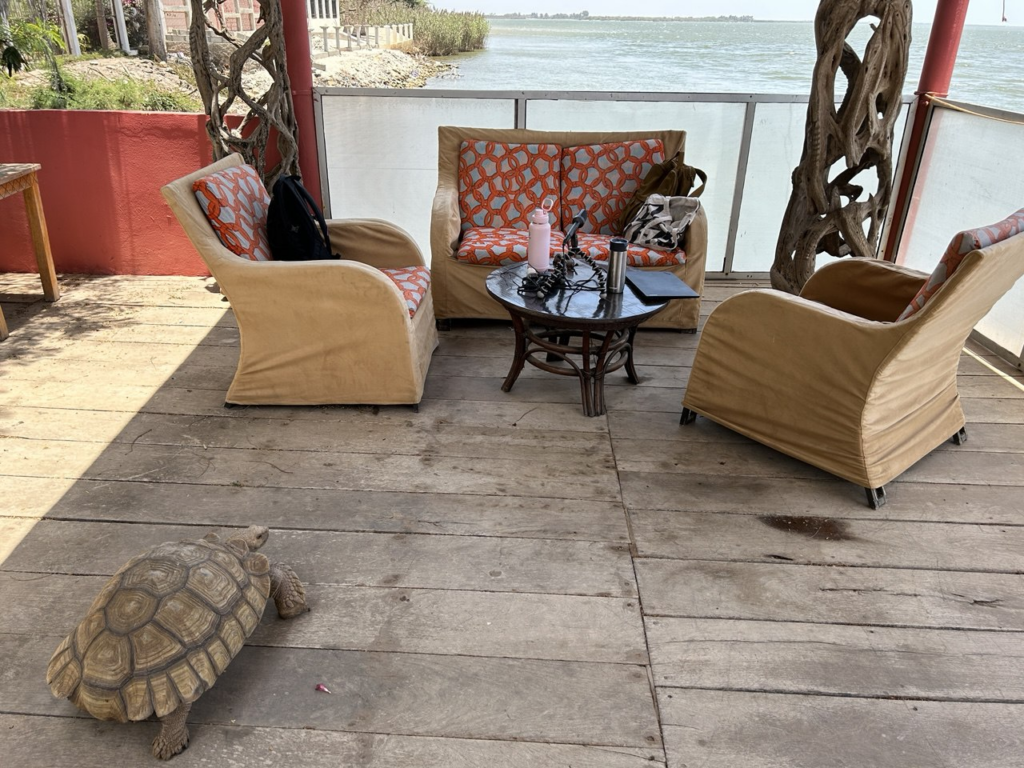
Brandon Chaperon spent 5 weeks in Saint-Louis, Senegal conducting fieldwork on Wolof for his M.A. thesis on the Causative-Applicative syncretism.
McLing is happy to welcome three new graduate students to the Linguistics program, and one to the Ad Hoc MA in Indigenous Language Revitalization!
Nicolas Poisson (he/him) is particularly interested in logic, formal semantics and pragmatics, specifically topics like presupposition, scalar implicatures, questions and conditionals. He studied in a multidisciplinary Bachelor’s program in Marseille (France), followed by an MA in Cognitive Sciences in Paris at the Ecole Normale Supérieure. Beside his interests in literature, in his spare time he enjoys playing chess, bouldering and trying to learn bass.
Sama’a Salama is an aspiring fieldwork semanticist working in the fields of evidentiality, epistemic authority, and focus. Thus far this research has focused on epistemic authority in Imbabura Kichwa and ħatta/ʔslan (‘even’) in Egyptian Arabic as an undergrad at the University of Ottawa. Sama’a is interested in incorporating experimental eye-tracking methods within fieldwork as well as expanding how we think of evidentiality. Beyond academics, Sama’a enjoys reading, writing, and martial arts (Karate & Muay Thai).
Clara Tran is primarily interested in second language acquisition, especially regarding sentence processing and sound production. Her target population so far has been Vietnamese learners of English. She also finds sociolinguistics intriguing as she spends (a lot of) time observing Internet language and people giving opinions about language. Clara completed her B.A. Honours in Linguistics, with a minor in Psychology, at Saint Mary’s University (Halifax, NS). She enjoys cleaning/tidying her living space, grocery shopping, cooking, playing guitar, learning new things, some of which must be done with music.
Arihwisaks Colin Benedict (He/Him) is Kanien’kehà:ka Wolf Clan from the Akwesasne Mohawk Territory. He is interested in Kanien’kéha Adult-Immersion Teaching Methodology and Kanien’kéha dialect preservation in Akwesasne. He is a graduate of the Onkwawén:na Kentyóhkwa immersion program in Ohswé:ken. He also has a B.A. from Six Nation Polytechnic’s Ongwehoweh Language program, and a B.S. from Cornell University’s School Industrial and Labor Relations. He enjoys hockey, waterskiing, and hiking.
Congratulations to Henrison Hsieh (PhD 2020, Beyond Nominative: A broader view of Tagalog A-bar-dependencies), who has recently started as an Assistant Professor at National Tsing Hua University in Taiwan!
As of June, Eva Portelance started a position as Assistant Professor of machine learning in the Decision Sciences department at HEC Montréal and Mila – Quebec AI Institute. She was previously a postdoctoral fellow with Timothy J. O’Donnell and Siva Reddy. Eva is also a BA Honours alumnus in the department from 2017.
Title: Exhaustive control as movement: The case of Wolof
Abstract: This paper investigates control constructions in the Niger-Congo language Wolof, which offers several insights into the phenomenon of control. First, I show that one and the same predicate can take infinitival complements of different sizes, giving additional suport to the claims in Wurmbrand (2014c, 2015), Wurmbrand and Lohninger (2023). Next, I present arguments in favor of Grano’s (2012, 2015) claim that Exhaustive Control (EC) and Partial Control (PC) are derived via different strategies, specifically, that EC is the result of movement (Hornstein 1999 et seq.). Control in Wolof is only exhaustive, both with cross-linguistically typical EC predicates and with typical PC predicates, and, notably, all control constructions in Wolof restructure, and all control verbs are monotransitive, properties that usually characterize EC, but not PC predicates. This confirms a correlation between EC, restructuring, and monotransitivity argued for by Cinque (2004, 2006) and Grano (2012, 2015). While Cinque’s and Grano’s approaches treat EC predicates as functional verbs, I argue that this bundle of properties cannot be a simple consequence of monoclausal syntax and propose that movement of the subject from the infinitival into the matrix clause must be available in bi-clausal constructions as well, supporting the view that at least one type of control is derived via movement, and does not involve PRO. An additional argument for this claim comes from ditransitive verbs: I show that Wolof does not have object control, and attribute this property to the larger size of infinitival complements in ditransitive constructions, resulting in the subject movement into the higher clause being impeded.
Michaela Socolof successfully defended her dissertation “Partial compositionality” on July 23. In September she will be starting a 2-year NSF SBE Postdoctoral Research Fellowship in the Department of Brain and Cognitive Sciences at MIT, supervised by Roger Levy.
Congratulations to Jacob Louis Hoover, who successfully defended his dissertation titled “The Cost of Information: Looking beyond Predictability in Language Processing” on July 22.
Jacob has accepted a 2-year NSF SBE Postdoctoral Research Fellowship, to work with Roger Levy in the department of Brain and Cognitive Sciences at MIT. The position starts in September, and focuses on algorithmic models of incremental language comprehension.
In more good news, Jacob is also getting married in September, and will be adding a new last name, going by Jacob Louis Hoover Vigly in future.