
McGill @ [motʰ] 2025

This year’s Montréal-Ottawa-Toronto-Hamilton Phonology/Phonetics Workshop ([motʰ] 2025) was held at the University of Toronto on April 4 and 5.

Presentations by McGill students and faculty included:

  • Amanda Doucette, Timothy J. O’Donnell, and Morgan Sonderegger — “Causal discovery of lexical constraints”
  • Massimo Lipari, Eleanor Lawson (University of Strathclyde), and Jane Stuart-Smith (University of Glasgow) — “The role of dialect and tongue shape in English /ɹ/ formant dynamics”
  • Irene Smith and Meghan Clayards — “Perception of PIN-PEN merger in Southern and non-Southern American-English listeners”
  • Alex Zhai and Meghan Clayards — “Variation in lexical bias in speech perception: Individual differences, contrast-specific effects, and the role of L1 background”
  • Jeanne Brown — “Gender and age effects of creaky voice acoustics: Mediation by f0”
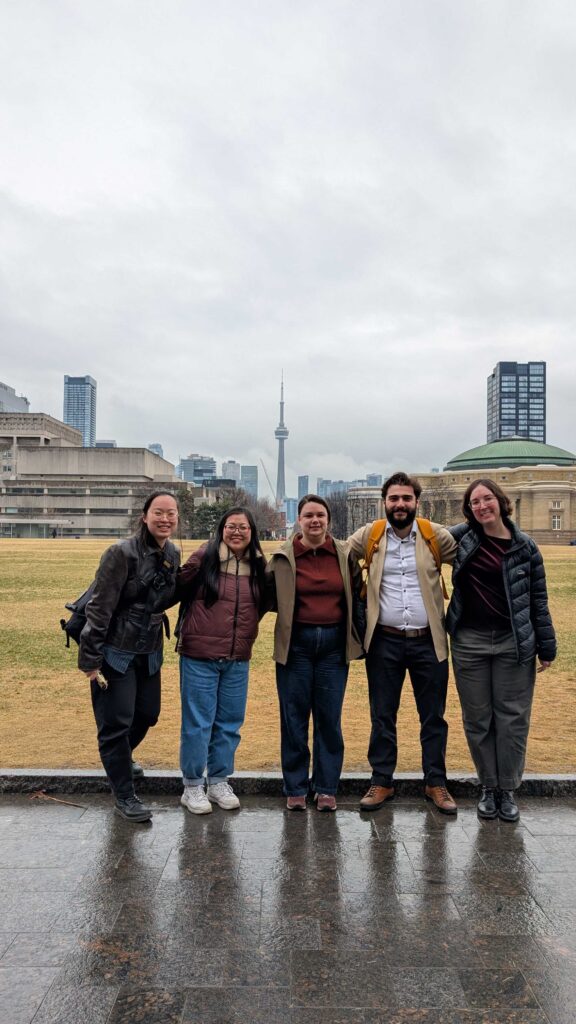
Conference participants (from left to right): Alex Zhai, Jeanne Brown, Irene Smith, Massimo Lipari, and Amanda Doucette

McCCLU @ McGill

Over the weekend, LingUA hosted the 11th edition of the McGill Canadian Conference for Linguistics Undergraduates (McCCLU). The event featured numerous talks and poster presentations from undergraduates in the department, showcasing the strength and diversity of undergraduate research at McGill. The conference also saw attendance from students from UdeM, UOttawa, and UMass. Students additionally had the opportunity to hear keynote presentations from James Crippen, Sigwan Thivierge, and Terrance Gatchalian. Attendees were later on tested on their mastery of linguistics at the Linguistics Olympiad.

Natalia Feu presenting “Influence Across Which Side of the Pond? A Comparative Analysis of the Vowel Systems of Bermudian English and PNW English”

Fiona Smith presenting her project “The Speech of Queer Women on Reality Television”
Jonas Baltakis presenting “I need that to know!: Analyzing the Size of Lithuanian Infinitival Clauses”

Conference attendees
Poster Presentation Session
Students attending the post-conference Linguistics Olympiad
Students solving problems at the post-conference Linguistics Olympiad

McGill at PLC 49

The 49th Penn Linguistics Conference took place April 5–6 at the University of Pennsylvania. Jessica Coon gave a keynote titled “Invisible inanimates and problems for polysynthesis in Kanien’kéha”, and recent McGill MA graduate Claire Henderson gave a talk (with Jennifer Nycz) “More on the menu than just p/æ/sta and p/ɑ/sta: phonetic gradience in second dialect acquisition”.

MCQLL, 4/9 — Jeanne Brown

At this week’s MCQLL meeting, Jeanne Brown will present “Investigating a face-gender effect in creaky voice perception.” We will be meeting this Wednesday, April 9, at 10 AM. Meetings are held in person in room 117 of the McGill Linguistics department and on zoom at https://mcgill.zoom.us/j/89609376104.

Abstract: In surveying the vast literature on creaky voice as an indexical feature, a striking production-perception mismatch emerges. Traditionally, creak has been associated with men‘s speech (e.g., Henton & Bladon, 1988, Klatt & Klatt, 1990), often relying on acoustic measures. Since around 2010 however, public discourse has perpetuated opposite gender associations, suggesting increased creaky voice use by women (e.g., Podesva, 2013; Yuasa, 2010), typically implementing perceptual coding of creaky voice. There is no convincing empirical evidence for any change in the acoustics of voice quality over time, but there is substantial evidence for recent change in popular perception of voice quality. The main goal of this project is to reconcile differences between the production and perception of creaky voice by ascertaining how its perception varies as a function of speaker attributes, specifically gender and f0. I will be presenting preliminary results from my perception experiment in which an ambiguously gendered voice, varying in voice quality (creak vs. modal), f0 (115Hz vs. 135 Hz vs. 155Hz), and face gender presented (M vs. F) is rated for perceived level of creak.

Syntax-Semantics Group, 4/7 — Laurestine Bradford

The Syntax-Semantics Group will be meeting on Monday, April 7 at 3pm in Room 117 of the McGill linguistics department. Online participants can join with this link: https://mcgill.zoom.us/meeting/register/16ZiB1ATRMGSUxbkGOJGvw.

Laurestine Bradford (McGill) will be discussing “So many ways to be done: Culmination and maximality in Tlingit.” Here is Laurestine’s abstract:

Tlingit perfectives do not generally entail culmination of the event they describe. To state unambiguously that an event culminated, one adds the preverbal clitic yan. However, culmination can only be expressed this way for certain kinds of verbs with clear associated scales. With other verbs, yan has a range of meanings that do not seem to involve event completion per se. Laurestine will present possible and impossible uses of yan and ideas toward an analysis in terms of maximality on scales. Of relevance will be implicit scales of change, pseudoincorporation, and how agentivity affects aspectual class.

McCCLU, 4/5-4/6

For the first time in five years, LingUA is hosting the 11th edition of the McGill Canadian Conference for Linguistics Undergraduates (McCCLU). The conference will take place April 5-6th, showcasing the work of linguistics undergraduates at McGill and elsewhere. All members of the department are invited to attend! The full schedule of the conference is as follows:

MCQLL, 4/2 — Austin Kraft

At this week’s MCQLL meeting, Austin Kraft will present “Motivating morphology in semi-supervised tokenization.” We will be meeting this Wednesday, April 2, at 10 AM. Meetings are held in person in room 117 of the McGill Linguistics department and on zoom at https://mcgill.zoom.us/j/89609376104.

Abstract: Tokenization is fundamental for computational linguistics and NLP. An input text is segmented into smaller pieces such as words or sub-words, which are then the basic units for language modeling and downstream tasks. However, this fundamental process has been largely understudied in how it can be formalized (Gastaldi et al. 2024), implemented, and potentially related to languages’ morphological patterns. Many contemporary NLP applications tokenize using Byte-Pair Encoding (BPE; Sennrich et al. 2016), an unsupervised algorithm that merges the most frequent adjacent characters in an input text. In the first part of this talk, I will provide overviews of BPE, its tendency to misalign with morphology to the detriment of downstream performance, and Bauwens and Delobelle’s (2024) proposed solution in their “BPE-knockout” method for Germanic. I will spend the second part of the talk motivating morphological semi-supervision for tokenization, particularly for languages less often represented in computational linguistics and NLP.