Sonderegger & Sóskuthy in Journal of Phonetics

A new paper by Morgan Sonderegger and Márton Sóskuthy (UBC) titled “Advancements of Phonetics in the 21st century: Quantitative data analysis” has just been accepted to the Journal of Phonetics. A preprint is available here.

Abstract: Phonetic research in the 21st century has relied heavily on quantitative analysis. This article reviews the evolution of common practices and the emergence of newer techniques. Using a detailed literature survey, we show that most work follows a mainstream, which has shifted from ANOVAs to mixed-effects regression models over time. Alongside this mainstream, we highlight the increasing use of a diverse methodological toolbox, especially Bayesian methods and dynamic methods, for which we provide comprehensive reviews. Bayesian methods, as well as frequentist methods beyond linear and logistic regression, offer flexibility in model specification, interpretation, and incorporation of prior knowledge. Dynamic methods, such as GAMs and functional data analysis, capture non-linear patterns in acoustic and articulatory data. Machine learning techniques, such as random forests, expand the questions and types of data phoneticians can analyze. We also discuss the growing importance of open science practices promoting replicability and transparency. We argue that the future lies in a diverse methodological toolbox, with techniques chosen based on research questions and data structure

Tur, Kamath, & Reddy selected to win a SAC award at NAACL 2025

Congratulations to Ada Tur, Gaurav Kamath and Siva Reddy! Their paper, ‘Language models largely exhibit human-like constituent ordering preferences’, was selected to win a Linguistic Theories, Cognitive Modeling and Psycholinguistics SAC award at the 2025 Annual Conference of the Nations of the Americas Chapter of the Association for Computational Linguistics (NAACL 2025). The paper appears here: https://arxiv.org/abs/2502.05670.

MULL Lab news

After a bit of a pause, meetings of the Montreal Underdocumented Languages Linguistics (MULL) Lab are back! Starting with a special kick-off event in May, and then continuing in the new school year, MULL meetings will be returning with a slightly updated schedule and focus. Going forward, MULL meetings will be monthly and provide opportunities for a mix of shorter, empirically-based presentations from Montreal linguists working on under-documented languages. 

Monthly MULL

  • MULL will meet once per month, at McGill, with a 4PM start time (day of week to be determined).
  • Each meeting includes 3-5 presentations, lasting 20 minutes each, followed by time to socialize (e.g., happy hour, free snacks).
  • With a focus on sharing new/puzzling data and getting feedback, speakers can present their research for 5-10 minutes and leave the rest for questions and discussion.
  • Talks do not need to theoretical, or conference-ready; new/early work and puzzles are welcome!
  • Presentations can be in English or French.

To get started, we are planning a kick-off Monthly MULL on May 8 at 4pm. This will be held in Room 404 (4th floor) of Thomson House on the McGill Campus.

If you are interested in presenting and/or would like to be added to the MULL mailing list, please reach out to Willie or Emma. As mentioned above, this does not need to be a fully formed analysis; any data that you want to share and discuss is good. You only need to talk for 5-10 minutes!

JournalLing Vol 3 and Vol 4

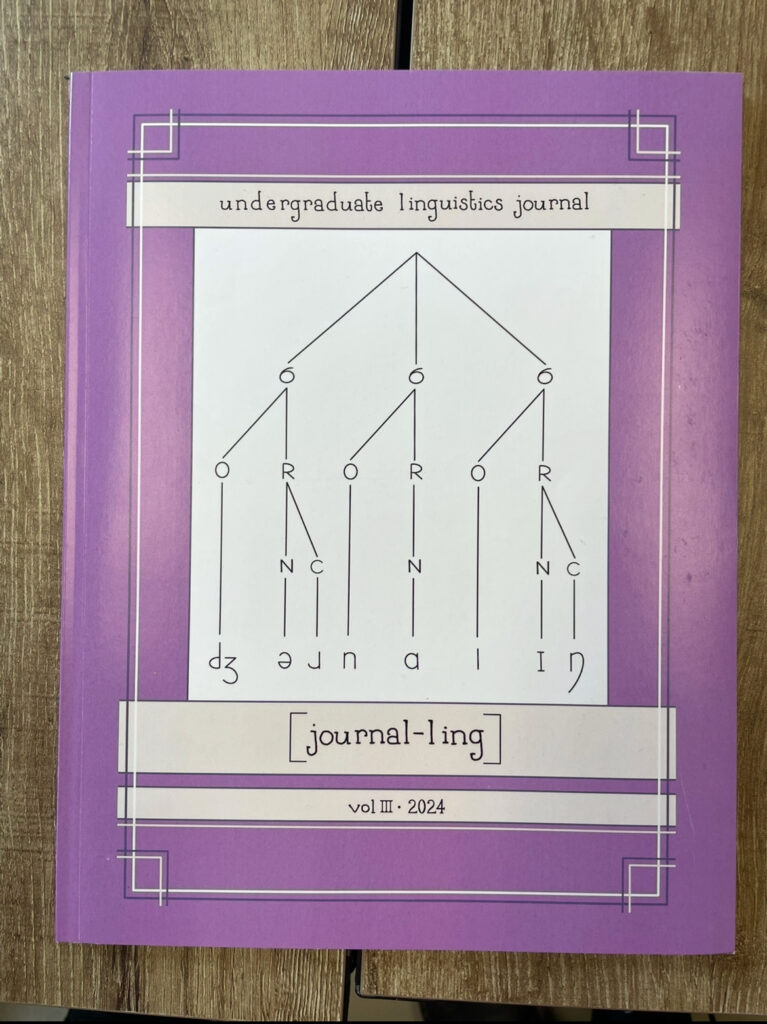
Two JournalLing (the McGill linguistics undergraduate journal) volumes, the 2023-2024 edition (Volume 3) and the 2024-2025 edition (Volume 4), were released this past Friday at the undergraduate Wine and Cheese social event. Jackson Corfield served as the Editor-in-Chief on the 2023-2024 JournalLing Team, and Allison McFarlane and Sophia Flaim served as Co-Editors-in-Chief on the 2024-2025 JournalLing team.

Volume 4 of JournalLing
Volume 3 of JournalLing

Syntax-Semantics Group, 4/14 — James Crippen

The Syntax-Semantics Group will be meeting on Monday, April 14 at 3pm in Room 117 of the McGill linguistics department. This meeting is the final regularly scheduled meeting of McGill’s Winter 2025 term. Online participants can join with this link: https://mcgill.zoom.us/meeting/register/16ZiB1ATRMGSUxbkGOJGvw.

Professor James Crippen (McGill) will be giving a presentation with the title “Optional ergative is subject focus in Tlingit.” Here is James’s abstract:

Tlingit has been described as having free word order (actually phrase order). This freedom crucially depends on the presence of -ch on a subject DP, a fact silently assumed in previous discussions. Without this -ch on the subject only SOV order is grammatical, implying that SOV is the basic word order in common with all other Na-Dene languages. The subject DP can have -ch but there is no distinct marking of object DPs so -ch has been described as ergative case. Since -ch need not occur, it appears to be an “optional ergative” as reported in a few other languages around the world. But case is not normally optional, and also -ch is always interpreted as focus on the subject which is unexpected for case marking. I argue that Tlingit -ch is not in fact ergative case, nor is it an indicator of the agent thematic role. Instead, -ch is the realization of a functional head in the left periphery that takes CP as its complement. The presence of -ch triggers movement of the subject DP out of the CP and up to FP. This analysis derives all non-SOV phrase orders as remnant movement to the peripheries driven by information structure. It also captures the apparent cataphora reported in earlier research, explains the disappearance of a- 3>3 agreement in some configurations with -ch, and the retention of a- for DP pronouns with -ch. Sentences where -ch appears on other phrases are the same lexical item merged as P selecting DP for instrument applicatives and CP for explanation clauses, both of which can cooccur with subject DP -ch.

McGill @ MOTH 2025

The Montréal-Ottawa-Toronto-Hamilton Syntax Workshop (MOTH) was be held on April 7 and 8, 2025 at the University of Toronto.

Presentations by McGill students, faculty, and alumni included:

  • George Bennett — “A causative recipe for Scandinavian pancake sentences”
  • Lisa Travis (professor emerita) and Ileana Paul (BA 1991, PhD 2000) — “The features of Voice Restructuring: Evidence from Tagalog and Malagasy”
  • Richard Compton (postdoc 2013-2014) and Joanie Bergeron (UQAM) — “Le statut du marqueur -gaanga- en inuinnaqtun”
Conference participants (from left to right): Susana Béjar (postdoc 2003-2005), Keir Moulton (postdoc 2009-2011), Sam Jambrović (current postdoc), Richard Compton (postdoc 2013-2014), Lisa Travis (professor emerita), Ileana Paul (BA 1991, PhD 2000), and George Bennett [photo credit: Pedro Mateo Pedro]
George presenting “A causative recipe for Scandinavian pancake sentences” [photo credit: Alkım Deniz Sarıkaya]