Syntax-Semantics Group 10/26: von Heusinger “Island constraints for conceptual anaphora.”

The Syntax-Semantics Group will hold its next meeting on Monday, October26th, at 1-2pm in Room 002 of the McGill linguistics department, 1085 Dr. Penfield. Online participants can join with this zoom link. 

Klaus von Heusinger (Universität zu Köln) will be presenting “Island constraints for conceptual anaphora.” Here is the abstract:

Conceptual anaphors, as in (1), from Morton Ann Gernsbacher (1991: 82; after Sidner, 1984), can access antecedents in negative contexts, in contrast to individual anaphors, which cannot.

(1) I want a new Harley Sportster. They are really powerful, but they’re gas-efficient.

In this talk, we compare the accessibility of antecedents for individual versus conceptual (“sense”) anaphors in (i) lexical islands, (ii) pseudo-incorporated nouns, and (iii) intensional contexts. We report results from an acceptability judgment study and an eye-tracking study. Our initial findings suggest that neither individual nor conceptual anaphors can access nouns within lexical islands. Furthermore, conceptual anaphors appear to be insensitive to pseudo-incorporated and intensional contexts, whereas individual anaphors are sensitive to these contexts.

McGill @ NELS 57

McGill linguists presented their work at this year’s meeting of the North East Linguistics Society (NELS 57), which was held at the CUNY Graduate Center October 16–18. Talks and posters by current and past McGillians included:

  • Emma Custer – Long-distance allomorphy in Pulaar is locally conditioned
  • Yanran Mou (BA 2024) & Heather Goad – Affix classes in English: exploring the effect of weight on demonym selection
  • William Johnston (PhD 2024) – On the asymmetry between source and goal in complex directional PPs
  • Lee Bickmore & Bronwyn Bjorkman (BA 2006) – Empty morphs in Kiwoso Chaga

You can see the full program here.

First PhD in Indigenous Language Revitalization to Mary McDonald

The McGill Reporter featured an article on Mary Tekahawáhkwen McDonald, known to many as Wá:ri, who graduated Monday with McGill’s first PhD in Indigenous Language Revitalization. Her dissertation is titled “Kanien’kéha Through the Eyes of a First-Language Speaker”, and was supervised by Jessica Coon, Heather Goad, and Noelani Arista (History).

The Ad Hoc program in Indigenous Language Revitalization was administratively housed in Linguistics until this past year when it moved to its permanent home in the new Faculty of Arts Institute for Indigenous Research and Knowledges (FAIIRK). The program is led by Noelani Arista, Jessica Coon, and James Crippen.

Read the full article here:

McGill at AMP 2026

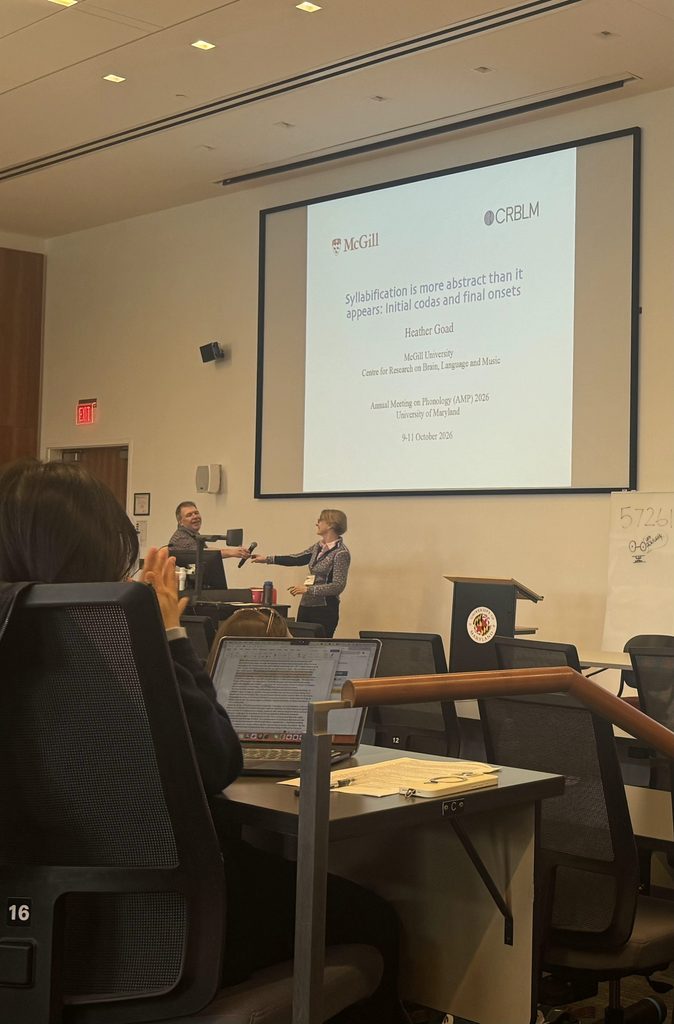
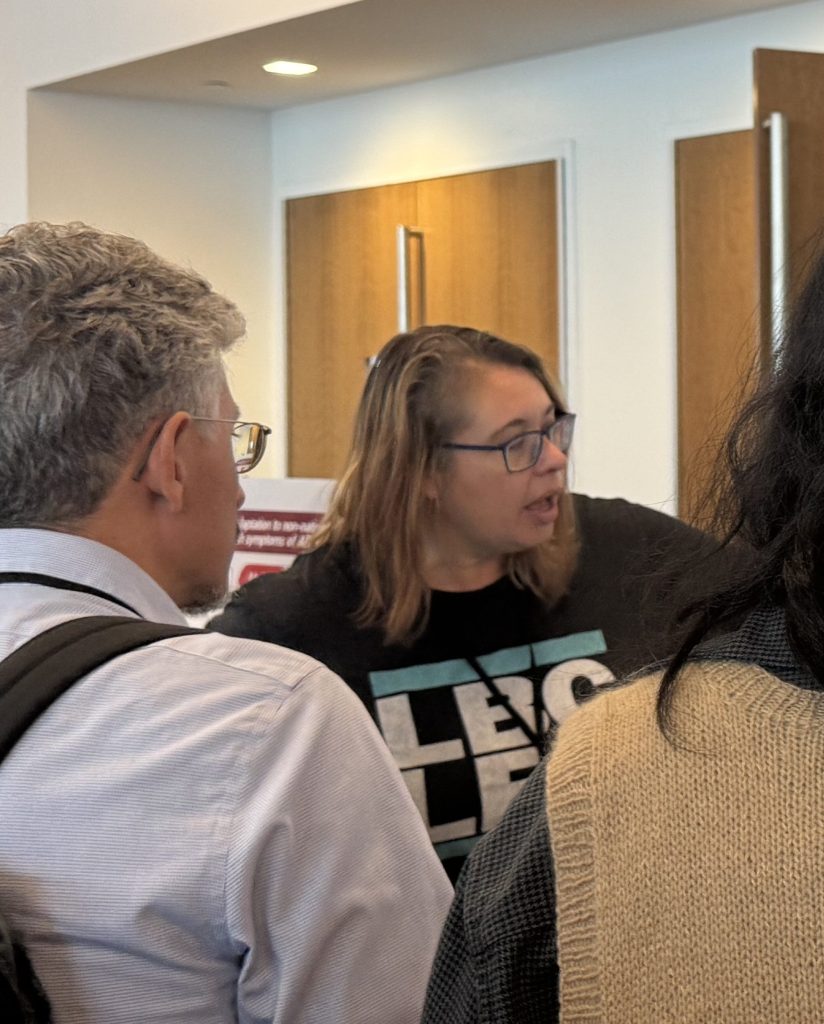
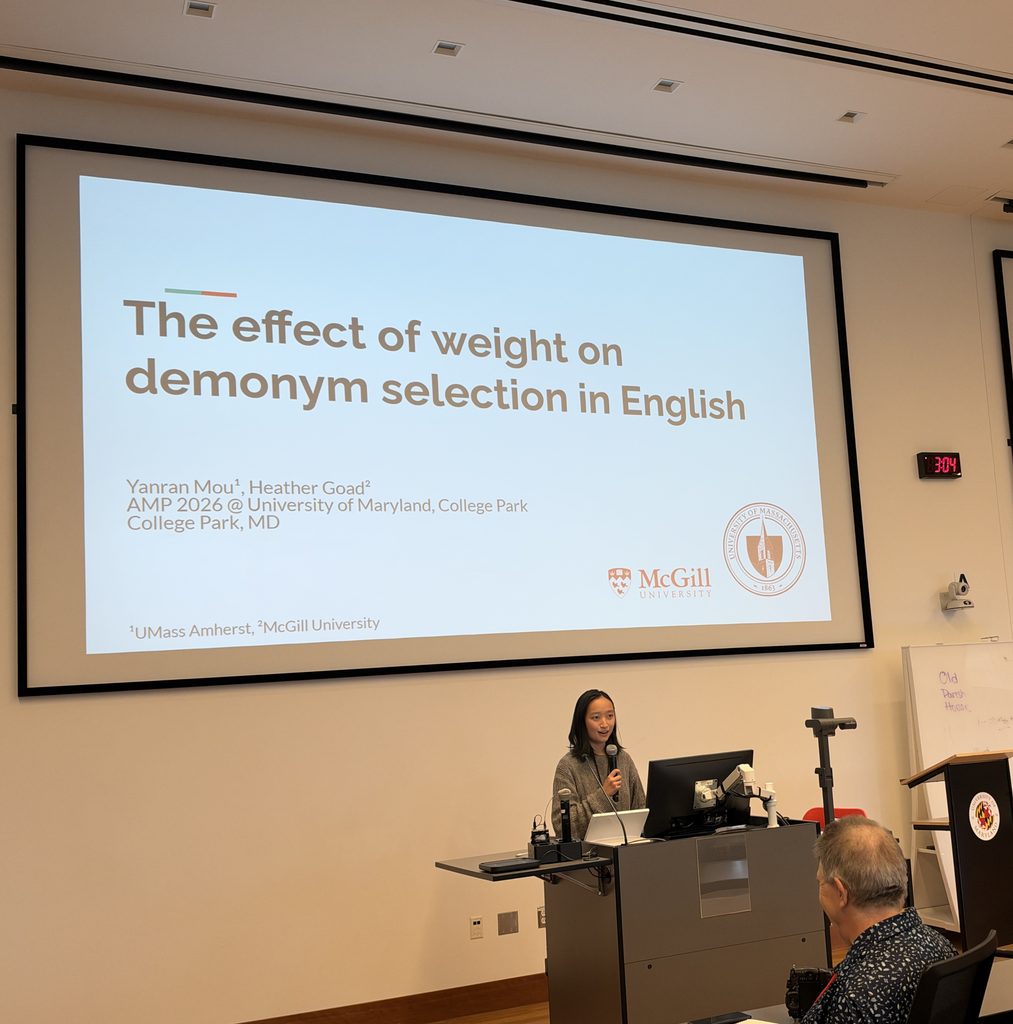
Several current and former McGillians were involved in talks and poster presentations at the Annual Meeting on Phonology (AMP) 2026, held October 9-11 at the University of Maryland. Heather Goad gave a plenary talk titled “Syllabification is more abstract than it appears: Initial codas and final onsets”. Other presentations by McGill affiliates included:

  • Yanran Mou (BA 2024) & Heather Goad – Are affix classes gradient? The effect of weight on demonym selection in English
  • Jeffrey Lamontagne (PhD 2021, course lecturer) & Anne-Michelle Tessier (BA 2001) – Interacting and variable processes in French liaison: GSRs at the word and phrase levels
  • Elliott Moreton, Jeffrey Lamontagne, Monica Nesbitt, Joseph Pater (PhD 1997) – Underlying representations affect allophone judgements in Canadian Raising
  • Shuang (Ivy) Zheng (BA 2022) & Youngah Do – Phonetic substance in the neural network implementation of phonological learning: the case of vowel harmony and vowel disharmony
  • Myriam Lapierre & Karee Garvin – Modeling segment strength in Q Theory: A case study of Ticuna

Syntax Semantics Group 10/19: Hannah Katinsky “’What’ is a verb? Question formation in Kanien’kéha.”

The Syntax-Semantics Group will hold its next meeting on Monday, October 19th, at 1-2pm in Room 002 of the McGill linguistics department, 1085 Dr. Penfield. Online participants can join with this zoom link. 

Hannah Katinsky (McGill) will be presenting “‘What’ is a verb? Question formation in Kanien’kéha”. Here is the abstract:

Languages like English have two ways of forming wh-questions: simple mono-clausal constructions (‘what did you see’) and bi-clausal cleft constructions (‘what is it that you saw’). However, multiple strategies of question formation are not necessarily available to every language. This talk discusses strategies of question formation in Kanien’kéha (Northern Iroquoian). I argue that only bi-clausal strategies of question formation are available in Kanien’kéha. Following Royer et. al (2026)’s analysis of wh-questions in Chuj, I present morphological evidence showing that certain Kanien’kéha wh-items should be treated as predicational elements, instead of part of the nominal domain. I discuss how this proposal can account for a few exceptional aspects of wh-questions in Kanien’kéha: the ban on multiple wh-questions, the lack of wh-in-situ, and the appearance of ‘discontinuous’ wh-questions.

Welcome picnic photos

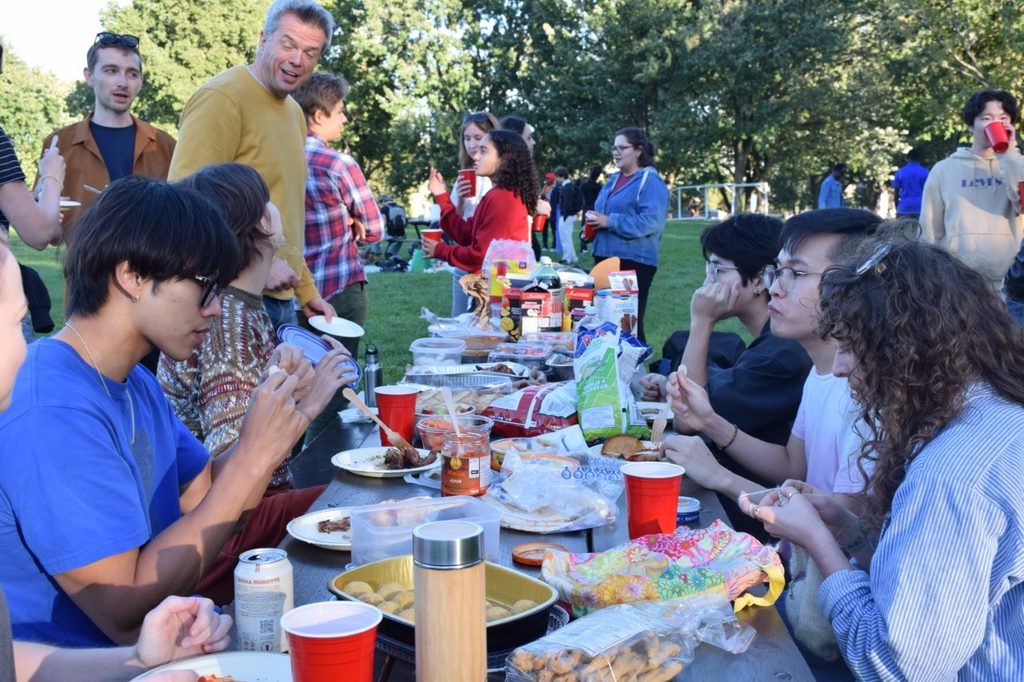
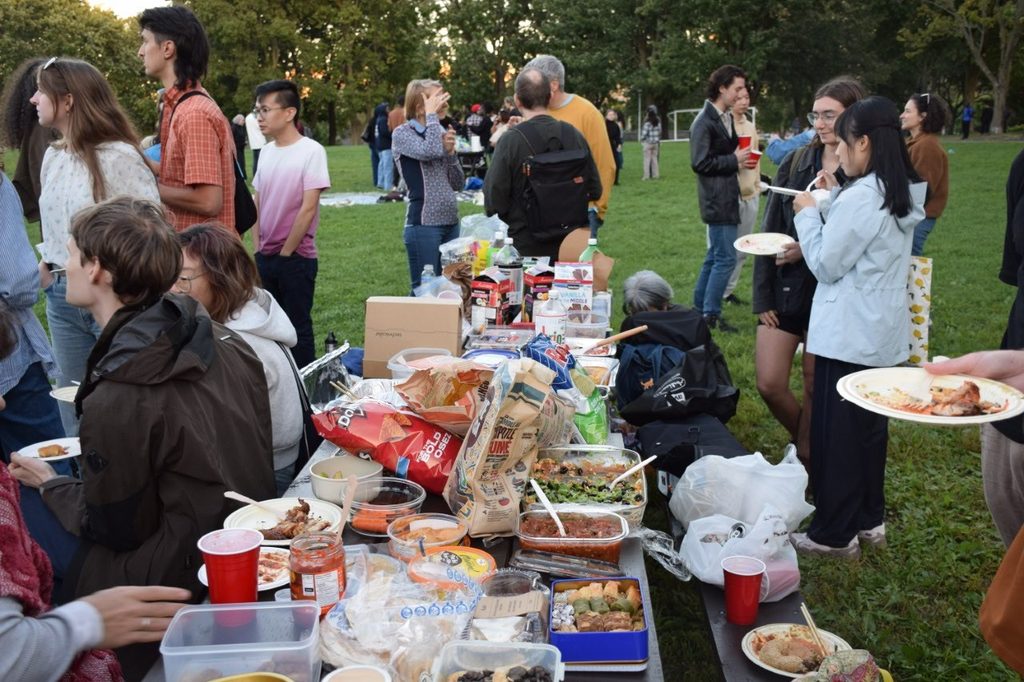
On September 18th, the Graduate Linguistic Association of McGill (GLAM) hosted a beginning-of-year picnic in Parc Jeanne-Mance. Good food and company abounded. Thanks to Ilya for documenting the event with some photos:

Syntax Semantics Group 09/28: Yosef Grodzinsky “How Deeply Human is Language? Chomsky, the Brain and the AI Fantasy.”

The Syntax-Semantics Group will hold its next meeting on Monday, September28th, at 1-2pm in Room 002 of the McGill linguistics department, 1085 Dr. Penfield. Online participants can join with this zoom link. 

Yosef Grodzinsky (The Hebrew University of Jerusalem ELSC) will be presenting “How Deeply Human is Language? Chomsky, the Brain and the AI Fantasy.” Here is the abstract:

The appearance of Deep Learning Models has swept the computational world. In the language domain, Large Language Models (LLMs) are said to have passed the Turing Test with flying colors, leading to a loss of interest in symbolic approaches to language, of the type practiced by theoretical and experimental (neuro)linguists. This has been best articulated, perhaps, by Geoffrey Hinton, a 2024 Physics Nobel Laurate and 2018 Turing Award winner, who in his 2024 Romanes Lecture at Oxford noted that “Chomsky did amazing things, but his time is over.”

            In my lecture (based on a book from which this talk inherited its title), I will try to convince you that Hinton’s dismissal of linguistic theory is neither justified conceptually, nor is it empirically supported. That is, LLMs may be reasonably well-engineered machines for specific language tasks, but they cannot be viewed as theories of the human linguistic capacity or the brain’s language machine. When tested against serious scientific benchmarks, they fail miserably. I will dwell on three aspects of this failure: 

·      Conceptually, LLMs as currently applied to language are unconstrained devices.

·      Empirically, LLMs are both too strong and too weak.

·      Methodologically, LLM-inspired tests that are aimed to detect brain activity patterns are inconsistent with results from linguistically-driven experiment in functional neuroimaging, and on neurological and neurosurgical patient populations.

Despite these deficiencies, and as I strongly believe in the great value of LLMs for an understanding of the brain’s language mechanisms, I will try to sketch a research program in which Deep Learning and symbolic approaches join forces to uncover the mysteries of the speaking brain.

Colloquium 10/2 – Lefteris Paparounas

The first talk in our McGill Linguistics Colloquium Series will be given by Lefteris Paparounas (UQAM), next Friday, October 2nd, at 3:30pm in Arts Building, room 150. The details of the talk are given below. 

Building verbal reflexives in Turkish and beyond

Many languages derive reflexive interpretations from ostensibly intransitive verbal forms (e.g. English ‘John bathed’; compare ‘John bathed himself’). Constructions of this general sort – verbal reflexives – raise important questions on the mapping between the syntax and the interpretation of arguments: what is the arity of these verbs; where does their surface subject originate; how does the reflexive reading arise; and what sort of reflexive reading is it? 

This talk will begin by arguing, based on joint work with Faruk Akkuş, that Turkish verbal reflexives provide an unusually clear window onto these questions. We will first see that Turkish verbal reflexives are syntactically intransitive and interpretively monadic: their surface subject is their only argument. Diagnosing the derivational history of this argument, we will find a striking instance of mixed behavior. The surface subject of verbal reflexives originates as a deep object; this much brings Turkish in line with the many languages that assign to verbal reflexives the same basic syntax (and morphology) as passives and unaccusatives. Crucially, however, the surface subject of verbal reflexives transits through an intermediate VoiceP-internal position on its way to becoming the grammatical subject; in this respect it is like the subject of transitives and unergatives, and unlike that of unaccusatives and passives. Turkish thus clearly evidences a movement-based derivation of verbal reflexivity, whereby the identification of thematic roles reduces to movement between the positions associated with these roles. 

Time permitting, we will ask whether this derivation should be understood as *the* analysis of verbal reflexivity across languages. A set of focused cross-linguistic comparisons informed by the Turkish findings will suggest a negative answer, reinforcing the conclusion that notional reflexivity does not receive a unique encoding in the grammar.

~~