Michael Wagner at Universität Wien & Ss. Cyril and Methodius University in Skopje

Michael Wagner presented two talks, “Prosodic focus and syntactic alternative projection” on October 2 at the Universität Wien and “The Iambic-Trochaic Law Revisited” on October 1 at the Faculty of Electrical Engineering and Information Technologies at Ss Cyril and Methodius University in Skopje. Abstracts are below.

Prosodic focus and syntactic alternative projection: Prosodic focus is often analyzed as flagging expressions for which alternative semantic meanings are salient in context. These alternative meanings can then compose pointwise, and play a crucial role in explaining contextual effects on prosodic prominence, but also constrain scalar implicatures, focus association, and related phenomena. This talk presents evidence that prosodic focus in fact relies on a syntactic mechanism of alternative generation. Focused constituents introduce a set of alternative expressions, which then ‘project’ in a pointwise way in syntax to generate sets of larger alternative expressions. Syntactic alternative projection sheds new light on a number of oddball phenomena, such as focus below the word level, metalinguistic uses of focus, expletive insertion within words, and echo questions, building the pioneering work on these phenomena by Artstein (2002). When looking at association with ‘only” or scalar implicatures, however, it’s not clear that these tap the same notion of alternatives. Instead, what we find looks more like semantic domain restriction.

The Iambic-Trochaic Law Revisited: When we hear a sequence of sounds, we often spontaneously perceive them as grouped, and we perceive a rhythm. Bolton (1894) famously discovered several regularities in how we perceive sequences of sounds, one of which is known today as the Iambic-Trochaic Law (ITL) of rhythmic perception. The ITL holds that alternating long and short sounds are perceived as sequences of binary groups with final prominence (“iambs”), while alternating soft and loud sounds are perceived as sequences of binary groups with initial prominence (“trochees”). This talk reports on production and perception experiments that illustrate how the ITL emerges as an epiphenomenon of the way listeners parse the signal along two, in principle orthogonal, perceptual dimensions: grouping and prominence. Some aspects of how this aspect of speech parsing works is surprisingly robust cross-linguistically, even though the ITL is not. The two perceptual decisions are orthogonal in principle, but they compete to explain overlapping sets of acoustic cues. The two decisions mutually constrain each other, much as in vision the perceptual decision about an object’s size competes with the decision about how far away it is.

Syntax-Semantics Group, 10/7 — Hannah Katinsky

The Syntax-Semantics Group will be meeting on Tuesday, October 7, at 3-4pm in Room 117 of the McGill linguistics department. Online participants can join with this link: https://mcgill.zoom.us/meeting/register/bQ4IXlJxTTShVcMHOosNtQ

Hannah Katinsky (McGill) will be presenting “Right dislocation in Korean.” Here is the abstract:

In many canonical head-final languages, the presence of postverbal elements is found to be grammatical under certain discourse conditions. The purpose of this talk is to provide a descriptive overview and theoretical analysis of postverbal phenomena in Korean, which is referred to as Right Dislocation (RD) in the Korean literature. Cross-linguistic analyses of RD are divided based on two major variables: whether the structure is assumed to be mono-clausal or bi-clausal, and whether the postverbal element is assumed to undergo movement or be base-generated in postverbal position. Following Ozturk (2014)’s analysis of Uyghur Turkic, I argue against a bi-clausal analysis and posit that the behavior of RD in Korean can be captured through a mono-clausal rightward movement approach. The availability of rightward movement in a given language seems to be correlated with EPP effects, allowing for cross-linguistic generalization and pointing towards a unified approach to postverbal phenomena in head-final languages.

P* Group, 9/30 — Kuilin Li

Our next presentation will be on Tuesday, September 30, from 1-2 pm in room 002 and on Zoom. Kuilin (me) will present a paper (attached).

Presenter: Kuilin Li

Paper: Beddor, P. S., Coetzee, A. W., Styler, W., McGowan, K. B., & Boland, J. E. (2018). The time course of individuals’ perception of coarticulatory information is linked to their production: Implications for sound change. Language, 94(4), 931-968.

The full schedule and all relevant documents are available on this Google Drive.

Colloquium, 10/3 — John Esling

The first talk in our 2025-2026 McGill Linguistics Colloquium Series will be given by Dr. John Esling (University of Victoria) next Friday, October 3rd at 3:30pm at Sherbrooke 680 in room 1041. The details of the talk are given below.

Title: What Polynesian, Iroquoian, Semitic/Cushitic, Nilotic, West African (ATR), Tibeto-Burman and Germanic languages share in laryngeal articulation

Abstract: Many phonetic and phonological labels have been attributed to the sounds that emanate from postures of the laryngeal articulator mechanism. All of the parameters that represent constriction of the mechanism are expressions of the folding (vs. unfolding) of the laryngeal mechanism and of the compaction (vs. expansion) of the epilaryngeal tube. The various reflexes (or potentialities) of the laryngeal constrictor mechanism are the basis for binary oppositions – minimal contrasts – as well as for coarticulatory synergies in the phonologies of many different languages. Examples are [h] vs. [ʔ] (open glottis vs. closed glottis) in Polynesian or Iroquoian languages; “pharyngeal” consonant/vowel oppositions (quintessential aryepiglottic sphinctering, also interacting with larynx height) in Semitic/Cushitic languages; phonation, constriction and larynx-height contrasts in Nilotic languages; [+ATR] vs. [–ATR] (open vs. constricted/ raised-larynx quality, also interacting with vowel quality) in West African languages; “lax/tense” register (open-larynx vs. raised-larynx/ “pharyngealized” quality, often interacting with phonation type and tone) in Tibeto-Burman languages; and the prosodic incidence of stød (laryngeal constriction on certain syllable rhymes with long sonority) in Danish. These oppositions are all examples of an unconstricted (or less constricted) state of the larynx contrasting with a greater factor of constriction (often with accompanying synergies) of the laryngeal constrictor mechanism. Even where constriction reflexes are not phonological, they can occur paralinguistically, e.g. in Germanic languages. Some Tibeto-Burman languages are shown to emulate laryngeal-series contrasts by contrasting (lingual) postures in the oral vocal tract.

Syntax-Semantics Group, 9/30 — George Bennett

The Syntax-Semantics Group will be meeting on Tuesday, September 30, at 3-4pm in Room 117 of the McGill linguistics department. Online participants can join with this link: https://mcgill.zoom.us/meeting/register/bQ4IXlJxTTShVcMHOosNtQ

George Bennett (McGill) will be presenting “Argument structure of emission verbs in Scandinavian.” Here is the abstract:

In this talk, I present some early-stage data and thoughts on verbs of emission (e.g., rain, snow, gush, flicker) in Scandinavian. I center the discussion on a couple of argument alternations in which the substance noun is the grammatical subject or introduced by the preposition “av” (in expletive subject constructions) that takes on the equivalent functions of the English by-phrase (introducing external arguments in passives) and of-phrase (the all-purpose DP-internal linker). I explore both options and discuss their implications: Either emission verb structures license substance-noun by-phrases with active voice (e.g., “it rains by a warm rain”), or they cannot take substance-nouns as internal arguments, requiring prepositional licensing (e.g., “it rains of a warm rain”). Either way, the behaviour of these verbs is not characteristic of unaccusative or unergative verbs, suggesting they might be truly avalent.

McGillians at Sinn und Bedeutung 30

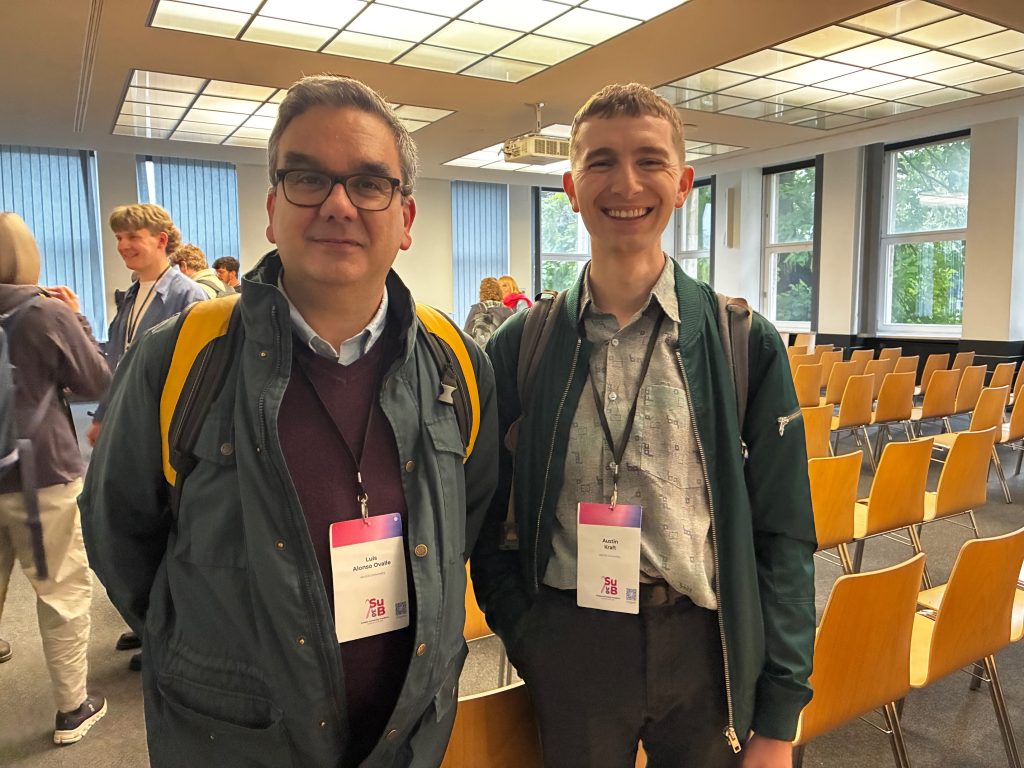
The program of Sinn und Bedeutug 30, held at Goethe University, Frankfurt, features several McGillians, listed below for your information:

  • Austin Kraft: “Two lives for numerals: Evidence from Javanese.”
  • Luis Alonso-Ovalle and Bernhard Schwarz “Pied-piping in the composition of degrees”
  • Giuseppe Magistro and Alexandra Simonenko (PhD 2014) “The emergence of “weak” definites.”

Despite much pressure and great demand, graphical reporters missed Simonenko. In their favour, however, it should be mentioned that they showed proof of courage once again and risked their lives and equipment on a slippery staircase to document Austin’s persuasiveness. Bernhard couldn’t travel, but was there in spirit, and was much missed by all.

McGillians at GALA 17

Vera Yunxiao Xia (BA 2018) and Lydia White presented a paper at the Generative Approaches to Language Acquisition Conference (GALA 17), at the Université de Tours, Tours, France, September 11-13th 2025, on Number mismatches in the processing of object relative clauses: Does featural Relativized Minimality operate in L2?

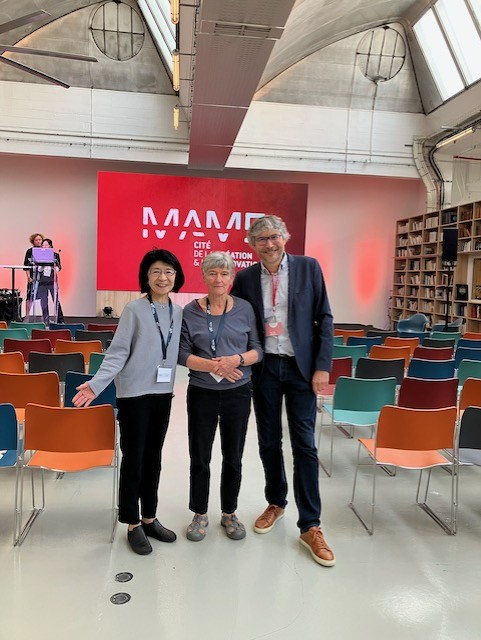
McGillians present at GALA (from left to right): Makiko Hirakawa (PhD 2000), Lydia White, Philippe Prévost (PhD 1997) (conference organizer).

MULL, 9/25 — Emma Custer, Maila Couture-Anctil, Bokai Liu

The Montreal Underdocumented Languages Linguistics Lab (MULL-Lab) is meeting Thursday, September 25 at 4PM in Rm 404 of Thomson House on the McGill Downtown campus. We will have three presentations on fieldwork puzzles, followed by a social hour. Talks include:

  • Exploring restrictions on negation and A’-movement in the Igala perfective — Emma Custer (McGill)
  • On the status of Wh-words in Scottish Gaelic — Maika Couture-Anctil (U de M)
  • Relative clauses in Northern Iroquoian languages — Bokai Liu (McGill)

The event is open to all linguists across Montreal! If you’d like to join the mailing list, please email willie.myers@mail.mcgill.ca.

Syntax-Semantics Group, 23/9 — Nicolas Poisson

The Syntax-Semantics Group will be meeting on Tuesday, September 23, at 3-4pm in Room 117 of the McGill linguistics department. Online participants can join with this link: https://mcgill.zoom.us/meeting/register/bQ4IXlJxTTShVcMHOosNtQ

Nicolas Poisson (McGill) will be presenting “A kind of puzzle with the definite determiner.” Here is the abstract:

This talk will present a puzzle in how romance languages refer to kinds using the singular definite determiner. One can show that two expressions with seemingly similar literal meanings (kind X doing Y) don’t give rise to the same reading. The talk will explore the shortcomings of pragmatic explanations for the at-least-two inference of bare plurals (that serves as a basis of comparison for the singular definite determiner) and propose a typology to explain why English and French behave differently regarding kind reference with singular definite determiner.