MULL, 10/30 @ UQAM

The Montreal Underdocumented Languages Linguistics Lab (MULL-Lab) is meeting Thursday, October 30 at 4PM in DS-1950* on the UQAM campus, followed by a social happy hour. Talks include:

  • An Illustration of Triestin Phonology — Alessio Tosolini (McGill)
  • Differential Object Marking in Mansi  — Varya Tiutiunnikova (McGill)
  • Data Sovereignty for Indigenous Languages — Anna Luisa Daigneault (Université de Montréal)

The event is open to all linguists across Montreal! If you’d like to join the mailing list, please email willie.myers@mail.mcgill.ca.

McGillians @ NELS 56

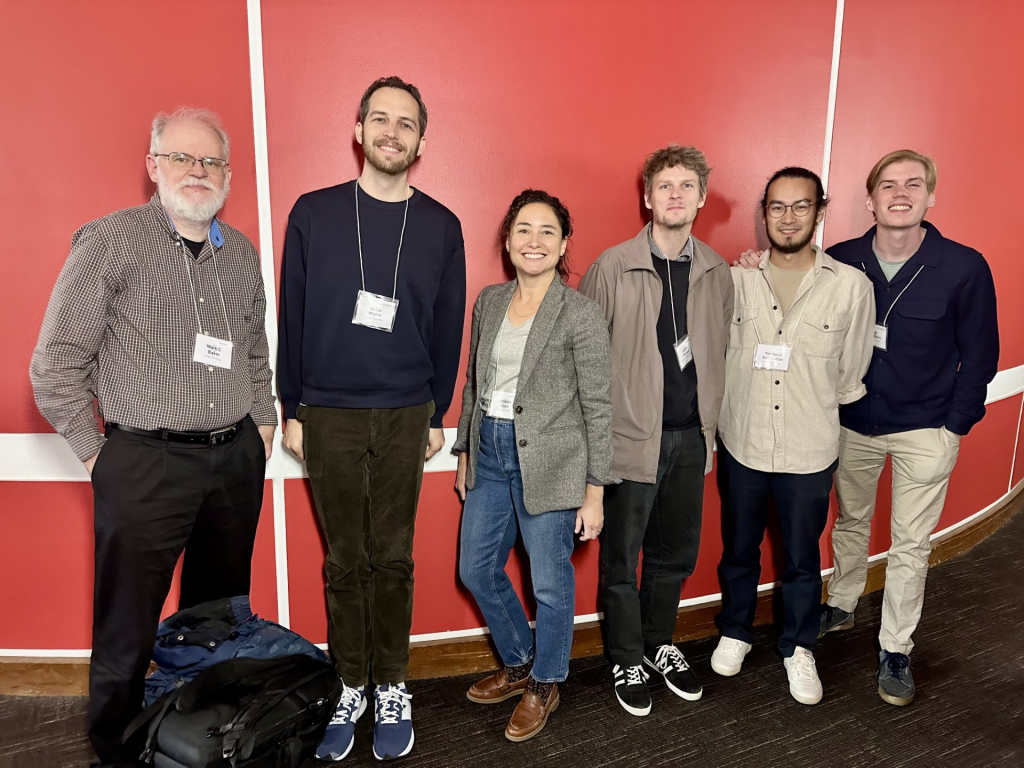
McGillians presented at the 56th meeting of the Northeast Linguistics Society, NELS 56, held this past weekend at NYU. Presentations by current McGill affiliates included:

  • Terrance Gatchalian, Jessica Coon, Lefteris Paparounas (UQAM) – ‘A unified syntax and semantics for Kanien’kéha statives’
  • Willie Myers – ‘The partitive prefix and exclamatives in Kanien’kéha: support for a degree account of exclamativity’
From left to right: Mark Baker (faculty ’86–’98), Willie Myers, Jessica Coon, Colin Brown (MA ’16), Terrance Gatchalian (PhD ’25), Max Blackburn (BA ’25)

Colloquium, 10/24 — Simon Charlow

The next talk in our 2025-2026 McGill Linguistics Colloquium Series will be given by Simon Charlow (Yale University) on Friday, October 24th at 3:30pm at Leacock 232. The details of the talk are given below.

Title: Effect-oriented interpreters for natural language

Abstract: Computer programs are often factored into ‘pure’ components — simple, total functions from inputs to outputs — and components that incur ‘side effects’ such as errors, changes to memory, parallel threads, abortion of the current command, etc. Drawing on recent work with Dylan Bumford (UCLA), this talk makes the case that human languages are similarly organized around the give and pull of pure and effectful processes and shows how denotational techniques from computer science can be leveraged to support elegant and illuminating semantic analyses of natural language. Taking this perspective helps us come to grips with the otherwise bewilderingly rich multi-dimensionality of linguistic meaning, from definiteness and context-sensitivity to indefiniteness and disjunction, from anaphora and apposition to quantification, focus, scope, and evaluation order.

Previously, effect-oriented approaches to semantics have been operationalized via type-shifters, scope-shifting, and silent elements in the syntax. The talk will point out some unsatisfactory aspects of this state of affairs, and motivate a new approach, in which the linguistic interpreter is modelled as a kind of effect-driven compiler. I’ll map out a conservative extension of standard techniques for ‘type-driven translation’ with resources that allow a linguistic interpreter to generate and handle arbitrary permutations of effects, and their interactions. We’ll use a computational implementation of these ideas to interactively generate analyses and explore predictions.

Syntax-Semantics Group, 10/21 — Varya Tiutiunnikova

The Syntax-Semantics Group will be meeting on Tuesday, October 21, at 3-4pm in Room 117 of the McGill linguistics department. Online participants can join with this link: https://mcgill.zoom.us/meeting/register/bQ4IXlJxTTShVcMHOosNtQ

Varya Tiutiunnikova (McGill) will be presenting “Bare NPs are choice functions in Uralic languages.” Here is the abstract:

Chierchia (1998) and Dayal (2004) proposed a unified approach to the interpretation of bare nouns in articleless languages. Bare NPs start as type <et> and appear in argument positions via type-shifting. The availability of the type-shifts is predicted by the Meaning Preservation (1). What is important here, is that the iota (ι) is ranked higher than the existential shift (∃), thus predicting that bare singulars will be definites, rather than indefinites. This has a strong implication: bare singulars are scopeless. (I am not going to touch ∩ and bare plurals in this talk).

(1)      {∩, ι} > ∃

I will show that in two Uralic languages (Kazym Khanty and Northern Mansi) bare NPs (1) can have existential interpretations; (2) can take various scope and even outscope islands. This data poses a challenge for Dayal’s Neo-Carlsonian theory, and I will argue for the choice-functional approach to bare nouns.

Royer & Coon and Myers in Language and Linguistics Compass

Two new articles by McGill linguists have been published in Language and Linguistics Compass!

Correlates of Object Raising in Mayan, by Justin Royer (PhD ’22) and Jessica Coon (https://doi.org/10.1111/lnc3.70013)

Abstract: Mayan languages show variation in the morphosyntactic distribution of absolutive objects. A now commonly-adopted analysis ties this variation to differences in object movement and agreement. In so-called ‘high-absolutive’ languages, objects consistently raise to a position above the ergative subject, where they are targeted for 𝜙-Agree by a probe on finite Infl⁰. In ‘low-absolutive’ languages, on the other hand, objects remain low and enter into 𝜙-Agree with a low functional head, v/Voice⁰. This paper surveys the constellation of empirical evidence for this basic division, specifically related to Ā-extraction constraints, the position of absolutive morphemes within the verbal complex, the availability of absolutive marking in nonfinite clauses, and the binding properties of absolutive objects. It then compares an object raising account with alternatives.

Expanding the Typology of Absolutive Syntax in Mayan: Evidence from Northern Mam, by Willie Myers (current PhD) (https://doi.org/10.1111/lnc3.70014)

Abstract: Past work on Mayan languages has divided the family into two groups based on syntactic ergativity: ‘high-absolutive’ languages in which objects raise to a position above the ergative subject and enter into Agree with a high probe and ‘low-absolutive’ languages in which objects remain low and enter into Agree with a low probe. This object raisingapproach has been proposed to correlate with a constellation of syntactic properties, related to Ā-extraction constraints, morpheme order, nonfinite embedding, and binding effects. This paper adds a third option to the typology based on data from a Northern Mam variety in which objects systematically fail to agree. Though it appears to fall outside of the established paradigm, I argue that this ‘no-absolutive’ syntax is also directly predicted by an object raising analysis which locates variation in the presence or absence of [EPP] and  𝜙-probe features on v/Voice⁰. To support this, I show how no-absolutive Northern Mam patterns as we would expect across all previously proposed correlates of object raising. This paper functions as Part II to Royer and Coon 2025, also in this volume.

P* Group, 10/7 — Josh Lee

Our next presentation will be on Tuesday, October 7, from 1-2 pm in room 002 and on Zoom. Josh will present his work.

Topic: High vowel devoicing in Seoul Korean spontaneous speech

All relevant documents (presentation schedules, abstracts, papers and slides/handouts) are available on this Google Drive.

Colloquium, 10/10 — Yoad Winter

The next talk in our 2025-2026 McGill Linguistics Colloquium Series will be given by Yoad Winter (Utrecht University) on Friday, October 10th at 3:30pm at Leacock 15. The details of the talk are given below.

Title: Reciprocal Alternations: Operators vs. Lexical Preferences

Abstract: One approach to verbs like ‘meet’, ‘hug’ and ‘fight’ derives their intransitive, “reciprocal”, meaning from the transitive entry, using a logical rule or a deleted reciprocal pronoun (‘each other’). Another approach interprets reciprocal meanings of verbs as lexicon-based, relating the meanings of the verb’s different sub-categorizations using “softer”, preferential principles, as found in other areas of the lexicon. Similar dichotomies between logical/derivational approaches and preferential approaches arise with other verb alternations (Dowty 1991). This talk addresses the systematic differences between reciprocal pronouns (‘each other’) and reciprocal verbs, especially in relation to non-maximal interpretations: both ‘the men fought’ and ‘the men fought each other’ can describe a barroom brawl where some men do not fight others. We link non-maximal reciprocity to other instances of interpretative ‘slack’, especially plural definites (Križ & Spector 2020). Experimental findings show that while both intransitive and pronominal reciprocals allow for non-maximality, intransitives are more tolerant of exceptions and are more influenced by the agents’ intentions. Preferential theories better explain these differences than derivational or logical approaches. Following Lasersohn’s (1999) view of slack quantification, we argue that pronominal reciprocals inherit ‘pragmatic halos’ from covert distributivity operators (Beck 2001), while intransitives derive their halos from slack relations with transitives, in a manner similar to other lexicon-based semantic relations. These “slack” relations are also examined in relation to reciprocal ‘with’ constructions (‘A fought with B’). We show that the same principles we use to explain non-maximality in collective intransitive forms (‘A and B fought’) naturally extend to ‘with’ forms, as they involve assigning lexical weights of agency features to different argument positions.

(Joint work with Imke Kruitwagen, Giada Palmieri, James A. Hampton and Joost Zwarts)

Jessica Coon in Chiapas, Mexico

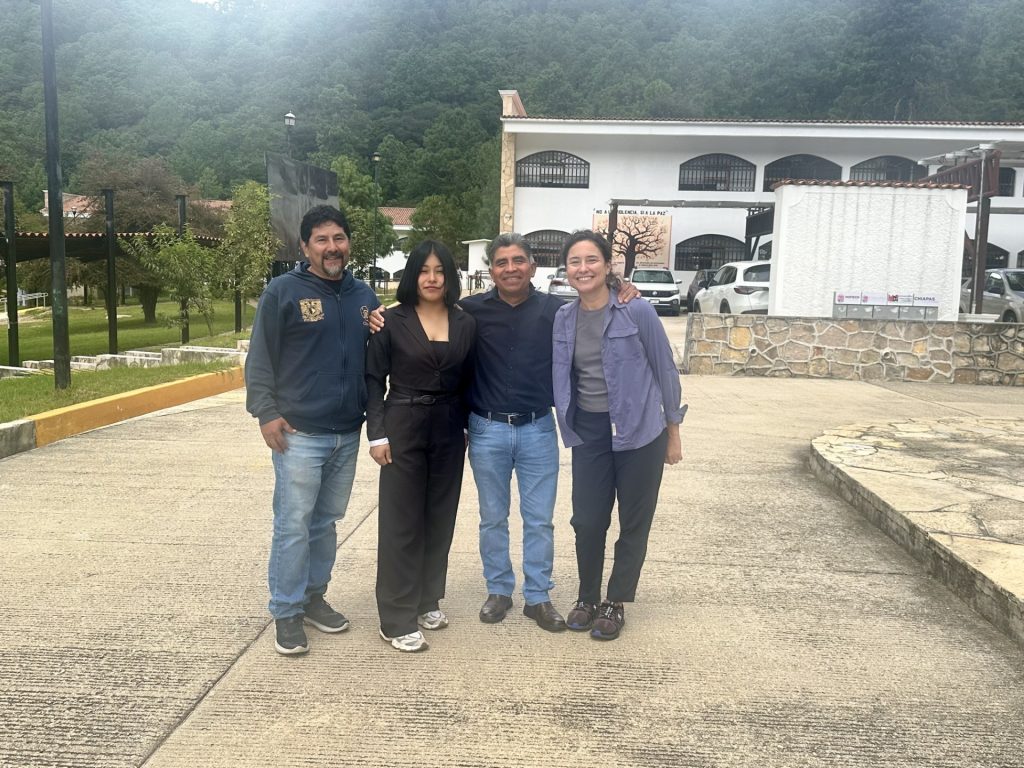
Jessica Coon spent the first few weeks of the semester in Chiapas, Mexico working with Ch’ol speakers and local collaborators on a project on animacy-driven hierarchy effects, as part of a larger collaboration with Stefan Keine (UCLA), Juan Vázquez Álvarez (CIMSUR-UNAM), and Michael Wagner. Jessica and Juan (with long-distance support from Michael) ran participants in a small animacy experiment, and also co-taught a week-long workshop on Ch’ol linguistics to students in the cultural studies program at the Universidades para el Bienestar Benito Juárez García in Palenque.

Jessica and Juan (center) with students in their workshop
Jessica with Ch’ol-speaking linguists Juan Vázquez Álvarez, Morelia Vázquez Martínez, and Silvestre Gómez Jiménez