There is no P* Group meeting this week. Hope to see you all again on October 2!
FestEval 2020
This year’s annual FestEval took place via Zoom. Masashi Harada, Jacob Hoover, Will Johnston, Esmail Moghiseh, Matthieu Paillé, Justin Royer, and Michaela Socolof all presented the results from their recent PhD evaluation papers. Congratulations all!
Justin Royer’s paper to appear in NLLT
Congratulations to Justin Royer, whose paper “Prosody as syntactic evidence: The view from Mayan” has been accepted for publication in Natural Language and Linguistic Theory! The paper is based on Justin’s second PhD Evaluation paper, supervised by Michael Wagner and Jessica Coon. Congratulations Justin!
Abstract: A subset of Mayan languages feature “prosodic allomorphy”, a phenomenon involving morphological alternations at certain prosodic boundaries. In previous work, Henderson (2012) proposes that prosodic allomorphs in K’iche’ provide evidence for non-isomorphisms in the correspondence between syntax and prosody. In this paper, I argue against this view by building on a related extraposition analysis in Aissen 1992. I contribute novel data from prosodic allomorphy from two Mayan languages, Chuj and K’iche’, and show that upon further inspection, there is strong evidence for a syntactic analysis different from the one assumed in Henderson 2012. The new syntax leads to several predictions that are borne out, and crucially, does not force us to posit mismatches, allowing for a one-to-one correspondence between syntax and prosody. By taking apparent instances of mismatches as suggestive that the syntactic analysis must be revisited, the proposal aligns with work such as Steedman 1991, Wagner 2005, 2010, and Hirsch and Wagner 2015. Finally, I discuss how the proposal could be restated within phase theoretic approaches to the interface between syntax and phonology, concluding that Mayan prosodic allomorphy poses an interesting challenge for such accounts.
Colloquium, 9/18 – Laura Dilley
The first talk in our 2020-2021 McGill Linguistics Colloquium Series will be given by Laura Dilley (Michigan State University) this Friday, September 18 at 3:30 pm.
If you are planning to attend talks, we would like you to register in advance with the following link (you only need to register once for the 2020-2021 McGill Linguistics Colloquium Series): https://mcgill.zoom.us/meeting/register/tJUrdumvrD8iH9IjXu6ziqP0IjxFkciJxwj9.
After registering, you will receive a confirmation email containing information about joining the meeting.
Title: “Language and social brains: Toward understanding mechanisms and typologies of prosody and tone”
Abstract: The past ~70 years of linguistic research have seen dramatic changes in the way researchers frame and conceptualize language as a human capacity and activity. In this talk I will present a synthesis of key insights from these past decades which leads to a view that language structure and meaning is grounded in social dynamics of perception, action, and cognition within ecological niches. Language perception does not entail, as some have argued, mere recovery of abstract linguistic units; rather, the very process of what those units are understood to be depends on social and ecological contexts. Framed in this way, innate brain mechanisms tuned to extraction of information over language-relevant timescales, together with the history of short- and long-term experiences over a lifetime, give rise to emergent understandings of meaning, as well as the apprehension of linguistic form and content. I will present the case of prosody, long held to be a mere overlay on the implicitly more foundational segmental underpinning, and challenge some long-held assumptions about the structure of prosody and how it contributes to meaning. With the benefit of insights of original thinkers who have come before, as well as the principle of Ockham’s Razor, I will argue that viewing human linguistic capacities as grounded in inherent temporal dynamics of social brains and bodies fosters novel connections among linguistic sub-disciplines and brings new questions into focus. Viewed through this lens, I assert that is possible to make headway toward understanding some of the most challenging domains of linguistic inquiry, namely typology, meaning and structure of tone and prosody.
MCQLL, 9/16 — Lightning Talks
As last week’s meeting was cancelled to make it easier for people to participate in the scholar strike, this week’s MCQLL meeting (1:30pm on Wednesday, September 16th) will be lightning talks by returning MCQLL lab members (that would have normally taken place last week). This will serve as an introduction to the type of work done at MCQLL, as well as provide a space to ask questions about our research and the lab in general.
Please make sure to register here beforehand so that you can get the meeting link. If you already registered last week, then there is no need to register again, just join with the link you got in your registration confirmation email.
P* Reading Group, 9/18 — Bing’er Jiang
Bing’er will lead discussion during this week’s P* Reading Group—the paper will be announced and distributed to the reading group mailing list prior to the meeting. P* Reading Group takes place on Fridays from 12-1pm on Zoom. The Meeting ID is: 956 5471 8344, or click this link to join: https://mcgill.zoom.us/j/95654718344. All are welcome to attend!
MCQLL, 9/9 — Lightning Talks
At this week’s MCQLL meeting (1:30pm on Wednesday, September 9th), there will be a series of lightning talks by returning MCQLL lab members. This will serve as an introduction to the type of work done at MCQLL, as well as provide a space to ask questions about our research and the lab in general.
Please make sure to register here beforehand so that you can get the meeting link.
The (tentative) meeting agenda is as follows:
- Announcements
- Lightning Talks
- Clarifying Questions here are fine, but please hold all discussion questions until the Q & A session.
- Q & A Session, including:
- Discussion questions relating to the talks
- Questions relating to the lab in general
Please don’t hesitate to reach out if you have any questions, comments, or concerns.
P* Reading Group, 9/11 — Planning Meeting
The P* Reading Group will be meeting virtually on Friday, September 11th, from 12-1 pm. The meeting will take place on Zoom (see Zoom info below). All are welcome to attend! This week’s meeting will focus on planning when group members will present, so please come with your preferred dates for presenting.
Congratulations Dr. Henrison Hsieh!
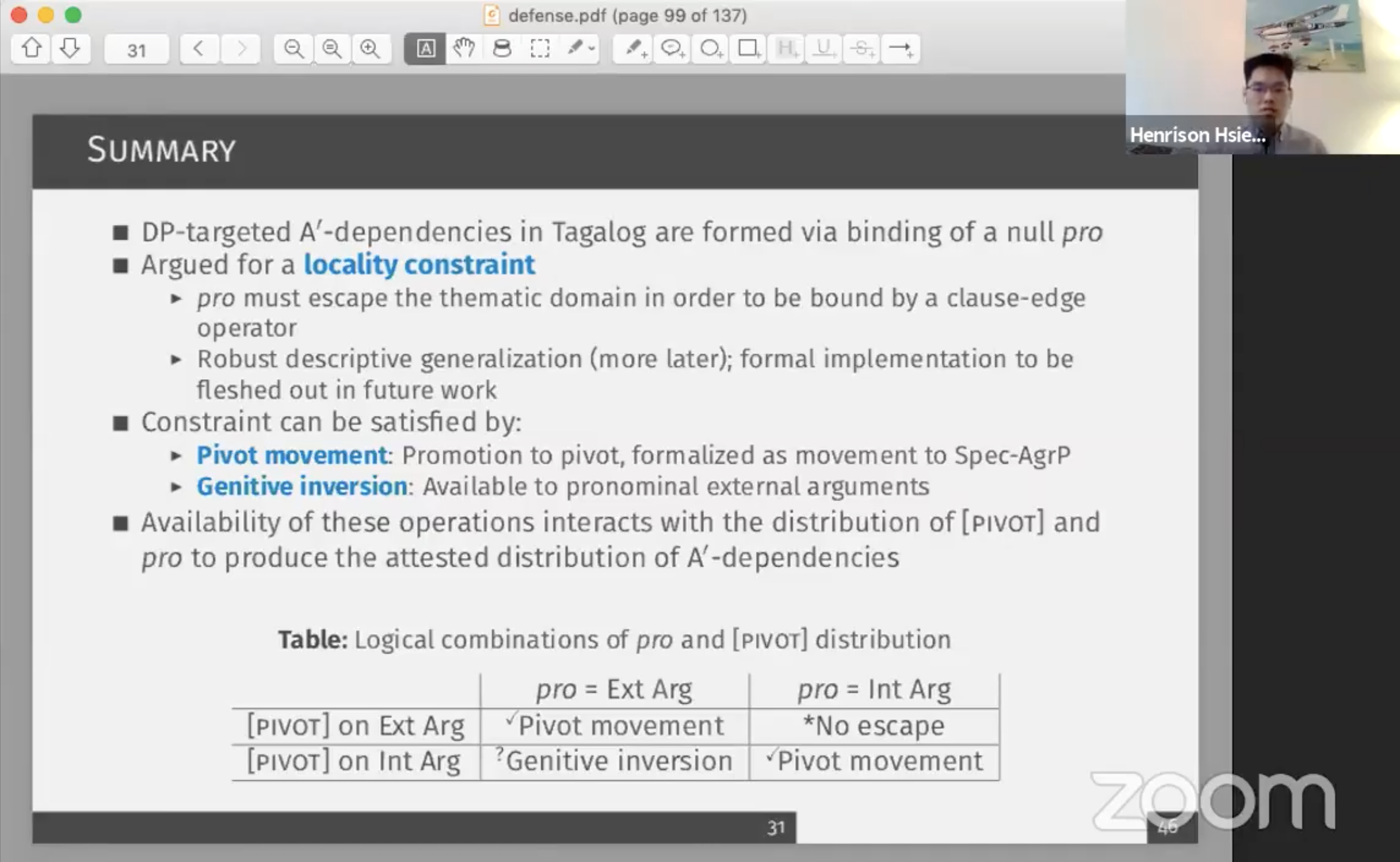
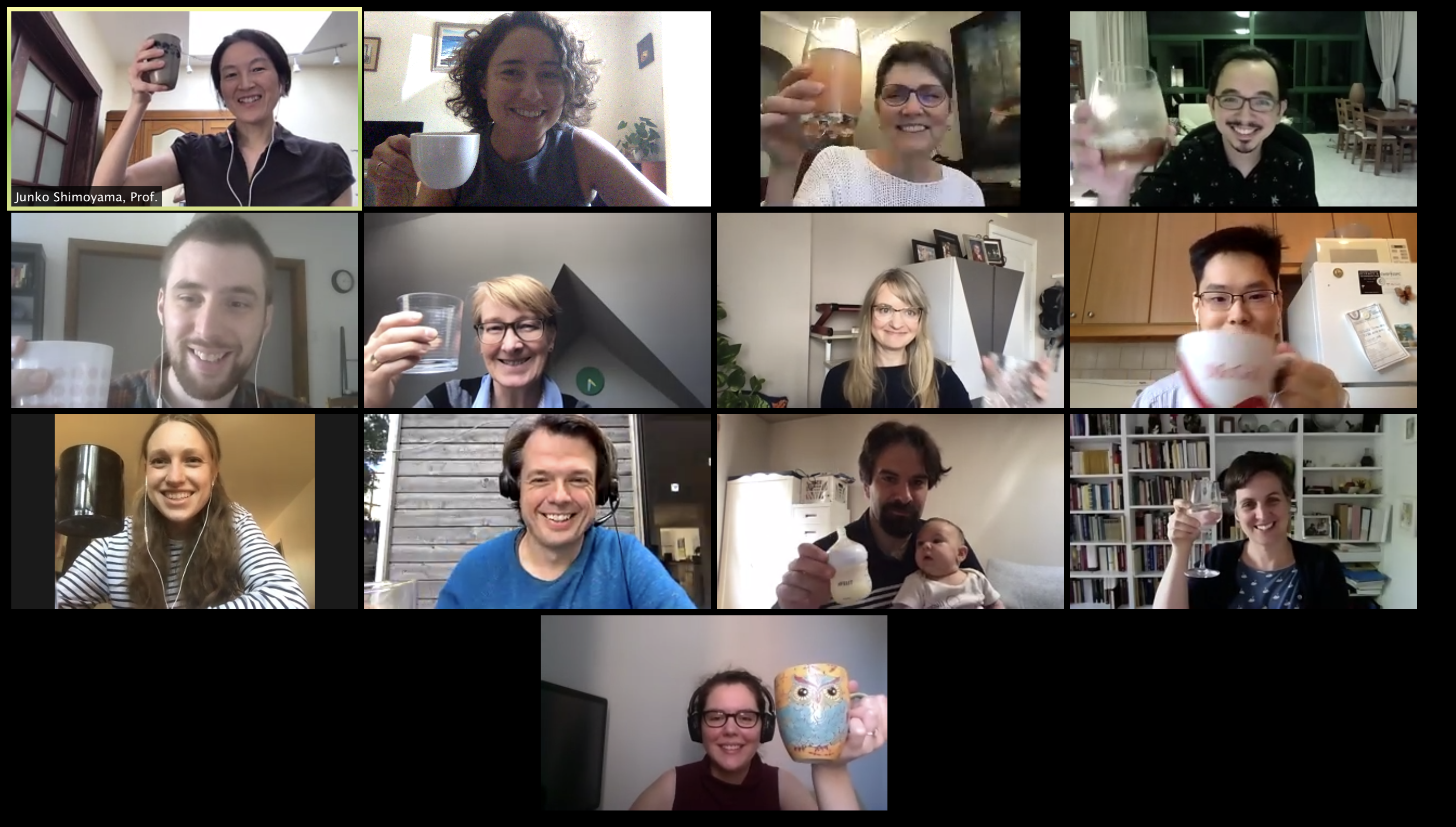
Congratulations to Henrison Hsieh, who successfully defended his doctoral dissertation “Beyond nominative: A broader view of A’-dependencies in Tagalog” last week. Photos of the Zoom defense and post-defense virtual celebration are below.