
P* Group, 4/8 — Naomi Sacks

Since next Monday is Easter Monday, our meeting will be temporally moved to Wednesday, April 8, 12-1pm in room 117 and on Zoom. 

Naomi Sacks will be presenting her study Vowel Hiatus Resolution in Mora-Timed Languages: Determining the Syllabicity of Adjacent Vowels in Japanese.

Abstract: Vowel hiatus, or adjacent, heterosyllabic vowels, are a crosslinguistically dispreferred phenomenon. Vowel hiatus may be resolved in various ways, including elision of one vowel, consonant epenthesis, vowel fusion, glide formation, and diphthongization. It can be difficult to determine whether vowel hiatus has been successfully resolved (turning into a monosyllabic long vowel) or not (two short vowels in different syllables) when the adjacent vowels are identical. In Japanese, pitch accent is expressed over the entirety of the syllable. Using voice recordings of a native speaker, I use changes in F0 to identify instances where vowel hiatus is resolved and where it is not. I find instances in which same vowel-sequences can audibly exhibit a contrast between long vowels and short, heterosyllabic vowels.

All relevant documents (schedules, abstracts, papers and slides/handouts) will be available on this Google Drive.
Syntax-Semantics Group, 4/9 — Brandon Chaperon

The Syntax-Semantics Group will hold its next meeting on Thursday, April 9th, at 2-3pm in Room 002 of the McGill linguistics department. Online participants can join with this link: https://mcgill.zoom.us/j/84180431566

Brandon Chaperon will be presenting “Generic argument-structure head in the Wolof causative-benefactive syncretism.” Here is the abstract:

This work provides an account for the crosslinguistically prevalent phenomenon of “causative-applicative syncretisms” (e.g., Jerro, 2017; Franco, 2019). Wolof (Atlantic; Niger-Congo) has a morphological syncretism between causatives and benefactives. In both cases, the verbal suffix –al is used: (i) a causative interpretation arises when it is added to clauses without an external argument (e.g., unaccusatives) and (ii) a benefactive interpretation arises when it is added to clauses containing an external argument (e.g., transitives). I analyze both clauses as encoding a causal relation between two events (Parsons, 1990; Pylkkänen, 2008). Given that the suffix used in both cases (i) co-occurs with the addition of an argument, (ii) contributes bi-eventive causative semantics, and (iii) is homophonous, I propose a unified analysis for treating –al as the spellout of a single generic argument-structure-manipulating head. This echoes Wood and Marantz’s (2017) proposal that heads involved in argument structure — like v, Voice, Appl, and P — can be reduced to a single head: i*; syntactic features are unnecessary when syntactic structure already reflects interpretative differences. I thus propose that –al can be treated as the spellout of i* in both causative and benefactive environments, which receives its interpretation via contextual allosemy.

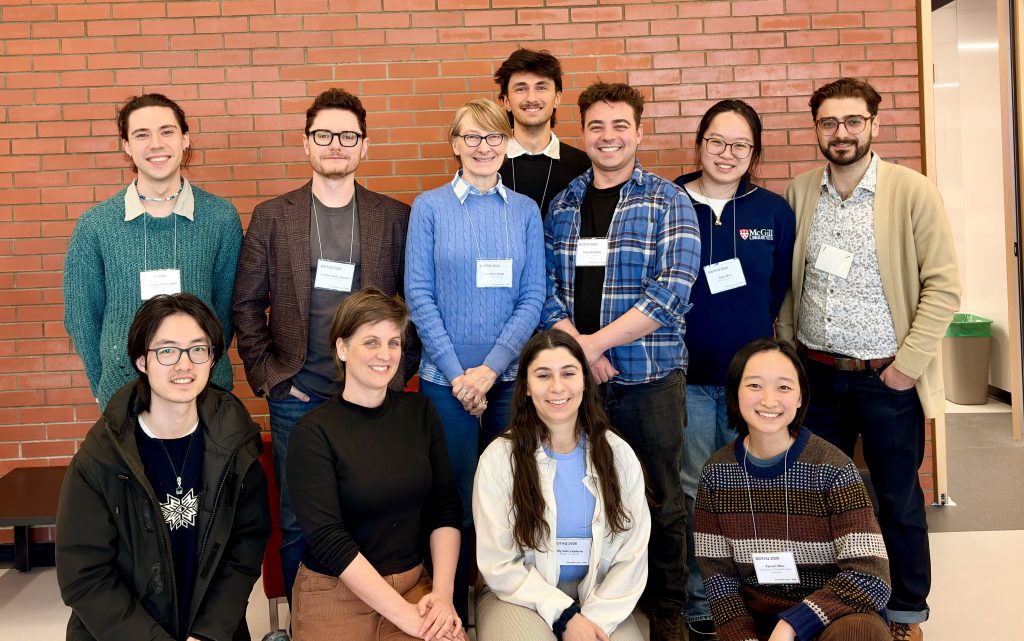
McGillians at MOThQ in Québec

Several McGillians, past and present, attended MOThQ Phonology and Phonetics Workshop in Quebec City on March 27-28. The program can be found here: https://mothq2026.netlify.app/program.html

Top L-to-R: Ray Cox-Casals (BA Hon 2025), Gui Garcia (PhD 2017), Heather Goad, Alessio Tosolini, Thomas Kettig (BA Hon 2013), Alex Zhai, Massimo Lipari
Bottom L-to-R: Tony Hu, Meghan Clayards, Myriam Lapierre, Yanran Mou (BA Hon 2024)
Missing: Emily Elfner (Post-doc 2012-14), Natalia Feu, Natália Guzzo (Post-doc 2016-19), Liz Smeets (PhD 2020), Morgan Sonderegger

Monthly MULL, 04/09 @ McGill — Daniel Laine, Manuel Archambault, Varya Tiutiunnikova

The Montréal Underdocumented Languages Linguistics Lab (MULL-Lab) will meet on Thursday, April 9th at 4PM in room 406 of Thomson House. There will be three talks followed by a social hour.

Talks include:

  • Perspectives on Haitian Creole Genesis: comparing Exceptionalism and Null Theory – Daniel Laine (Concordia)
  • Directionals in Chuj – Manuel Archambault (Université de Montréal)
  • Double dual constructions in Forest Nenets (<Uralic) – Varya Tiutiunnikova (McGill)

This event is open to all linguists across Montréal. Please email emma.custer@mail.mcgill.ca if you’d like to be added to the mailing list.

Jeanne Brown & Meghan Clayards in Laboratory Phonology

The article “Disentangling acoustic and social biases in creaky voice perception: The effects of f0 and face gender on creakiness ratings”, co-authored by Jeanne Brown and Meghan Clayards, has just appeared online at Laboratory Phonology: https://doi.org/10.16995/labphon.24285. The abstract is below.

Creaky voice has historically been associated with men’s speech, supported by acoustic studies. Since around 2010, however, sociolinguistic work alongside public discourse has perpetuated greater creaky voice use by women, typically implementing impressionistic coding. This study investigates whether this recent shift can be attributed to perceptual social and acoustic biases related to (perceived) speaker gender and pitch (f0), respectively. Using a matched-guise paradigm, 40 Canadian English listeners rated the perceived creakiness of the same modal and creaky voices—altered to have ambiguously gendered formants and median f0s (115, 135, 155 Hz)—paired with female and male faces. Bayesian regression analyses revealed strong effects of voice quality and moderate effects of f0: Creaky and lower-f0 stimuli were rated as creakier. No overall effect of face gender was found. However, a weak interaction between face gender and f0 suggests a possible gender prototypicality bias: At lower f0s, female faces were rated as slightly creakier than male faces and at higher f0s, male faces were rated creakier than female faces. These findings show that neither acoustic nor gender-based biases alone can account for widespread reports of women-led creaky voice use. Several possible explanations for this discrepancy are discussed.

P* Group, 3/30 — Yue Qiu

Next presentation will be on Monday, Mar 30, 12-1pm in room 117 and on Zoom. 

Yue Qiu, a visiting PhD candidate from the Basque Center on Cognition, Brain and Language, will be presenting her research ReadCalibration: Exploring the Links between Reading Acquisition and Speech Sound Processing.

All relevant documents (schedules, abstracts, papers and slides/handouts) will be available on this Google Drive.

Syntax-Semantics Group, 4/2 — Nicolas Poisson

The Syntax-Semantics Group will hold its next meeting on Thursday, April 2nd, at 2-3pm in Room 002 of the McGill linguistics department. Online participants can join with this link: https://mcgill.zoom.us/j/84180431566

Nicolas Poisson (McGill) will be presenting. Abstract is below.

The original Carlsonian claim that bare plurals unambiguously denote kinds received much support from Chierchia (1998), who posited an operator that allows a stage level predicate to combine with a kind to yield an existential reading. The local triggering of this operator explains the apparent ambiguity of bare plurals, that can denote kinds as well as regular properties in existentially quantified sentences. In this talk, we will see that this innocuous principle of composition, called Derived Kind Predication (DKP), as formulated by Chierchia, raises some issues for the composition of stage-level predicates, especially in a taxonomic context. Then we will motivate a parallel composition principle, Direct Object predication, that turns a kind-level predicate into an object-predicate, which compensate for some shortcomings of DKP. We will end the paper by specifying what this operator does and doesn’t do, by discussing some alternatives options to explain the readings it produces.

P* Group, 3/16 — Alex Zhai

Next presentation will be on Monday, March 16th, 12-1pm in room 117 and on Zoom. 

Alex will be presenting research from her thesis Lexical Recruitment in Perception: Effects of L1 Background, Contrast Type, and Proficiency.

All relevant documents (schedules, abstracts, papers and slides/handouts) will be available on this Google Drive.