Congratulations to Xuanda Chen, who successfully defended his dissertation, “Linguistic Experience and the Representation of Phonological Features: Perception, Processing, and Second Language Acquisition,” on August 5th!



Congratulations to Xuanda Chen, who successfully defended his dissertation, “Linguistic Experience and the Representation of Phonological Features: Perception, Processing, and Second Language Acquisition,” on August 5th!
On August 8th, Connie Ting successfully defended her dissertation, “Investigating Cross-linguistic Patterns of Intrinsic F0 Effects in Production and Perception.” Congratulations, Connie!


Brendan Gillon travelled to Japan for the last two weeks of April. He made three stops there: first in Tachikawa, a satellite city Tokyo; second in Kyoto; and third in Kobe. In Tachikawa, he gave a talk to Prof. Yusuke Kubata’s research group at the National Institute for Japanese language and Linguistics, in Tachikawa. The talk was based on a paper entitled “Foundations of Formal Natural Language Semantics” which will appear in the Springer Handbook of Linguistic Semantics: Bridging Theory, Philosophy and Cognition, edited by Parkash Mondal of the Indian Institute of Technology, Hyderabad. In Kyoto, Brendan met with Shoryu Katsura to finalize their translation of a Chinese text dating from the 6th century. In Kobe, Brendan gave a two day workshop on another Chinese text at Kobe Women’s University.
He then travelled from Japan to Shantou in southern China, where he spent three weeks with students from McGill University on exchange at Shantou University. While there, Brendan gave a talk entitled “The study of language in the classical world: China, India and Europe.”
Having returned to Montreal at the end of May, Brendan then travelled to Oxford where he participated in a conference, “New ideas for modern linguistics from Ancient India”, held at Wolfson College. There he gave a talk entitled “Type logical grammar and classical Sanskrit”.
Supported by the Graduate Mobility Award, Alex Zhai spent the summer at The University of Tokyo. She participated in Professor Yuki Hirose and Professor Manami Hirayama’s labs, presented at the Tokyo Circle of Phonologists workshop, and collected data from Japanese participants.

McLing would like to welcome Josh Lee to the Linguistics department! Josh is a postdoctoral researcher working with Morgan Sonderegger and Meghan Clayards.
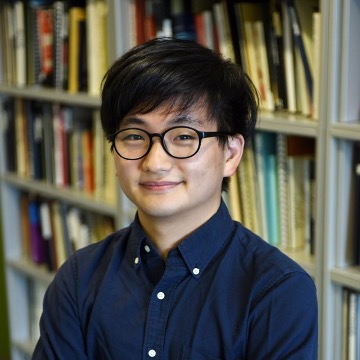
Seung Suk (Josh) Lee (he/him) works on corpus phonetics, prosody, and computational phonology. His main interest is studying how segmental realization is conditioned by prosodic structure in production and how it serves as a cue for prosodic structure in perception. He completed his BA degree at Indiana University Bloomington and recently received Ph.D. at UMass Amherst. His thesis, supervised by Kristine Yu, John Kingston and Mara Breen, is on the relationship between acoustic realization of laryngeal categories and prosodic structure in Seoul Korean. He plans to continue his investigation on acoustic correlates of prosodic structure in other languages using corpus data. Besides linguistics, he likes to watch (street) food documentaries, and watch soccer and (Korean) baseball.
A paper by Michaela Socolof (PhD ’24), Timothy O’Donnell, and Michael Wagner, “The idiom processing advantage is explained by surprisal,” recently appeared in Cognitive Science.
Abstract: It has been repeatedly found that idioms are processed faster than syntactically matched literal phrases, in both comprehension and production. This has led to debate about whether idioms are accessed as chunks or built compositionally, with different studies attempting to measure the effect of compositionality on processing, with differing conclusions. This paper looks at idiom processing through the lens of information update, in particular surprisal theory, which is a standard theory of sentence processing. Compositionality is just one aspect of a word’s predictability; we argue that surprisal, as an expectation-based theory, provides a more general unifying framework for understanding the idiom processing advantage. In this paper, comprehension and production experiments on verb-object idioms reveal that the idiom processing advantage can be largely explained by the fact that idioms have lower surprisal than matched literal phrases. The results indicate that the idiom advantage manifests primarily on the noun in verb-object idioms.
Socolof, M., O’Donnell, T. J., and Wagner, M. (2025). The idiom processing advantage is explained by surprisal. Cognitive Science, 49(7). doi: 10.1111/cogs.70085
PhD student Kuilin Li presented a poster titled “Cue Weighting in Mandarin Sibilant Perception & Imitation by Native Mandarin Speakers & Naïve English Speakers” at the 6th Phonetics and Phonology in Europe (PaPE) conference, held June 25–27, 2025. The event took place at the University of the Balearic Islands in Mallorca, Spain.

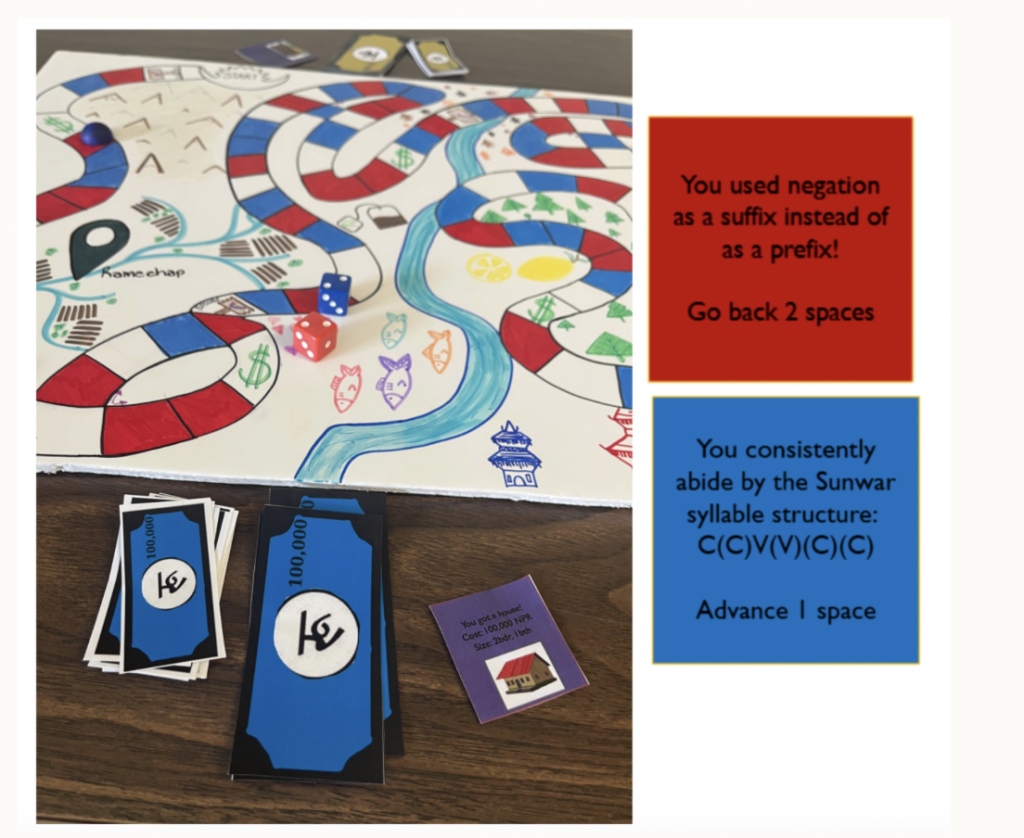
Some of the final projects from last semester’s LING315: Languages of the World (taught by PhD student Willie Myers) can be seen here. In the class, each student works with the grammar of an endangered language to learn about its phonology, morphology, syntax, and semantics. This semester’s final projects included:
Arihwí:saks Colin Benedict (MA), Terrance Gatchalian (PhD ’25), and Willie Myers (PhD) received the CLA Best Student Paper Award for their presentation called “Reversives, repetitives, and on-going telic events in Kanien’keha” at the annual meeting of the Canadian Linguistics Association.
Sophia Flaim (BA ’25) received an honorable mention for her talk “Information Structure and Word Order in Kanien’kéha”.
Congratulations to all!