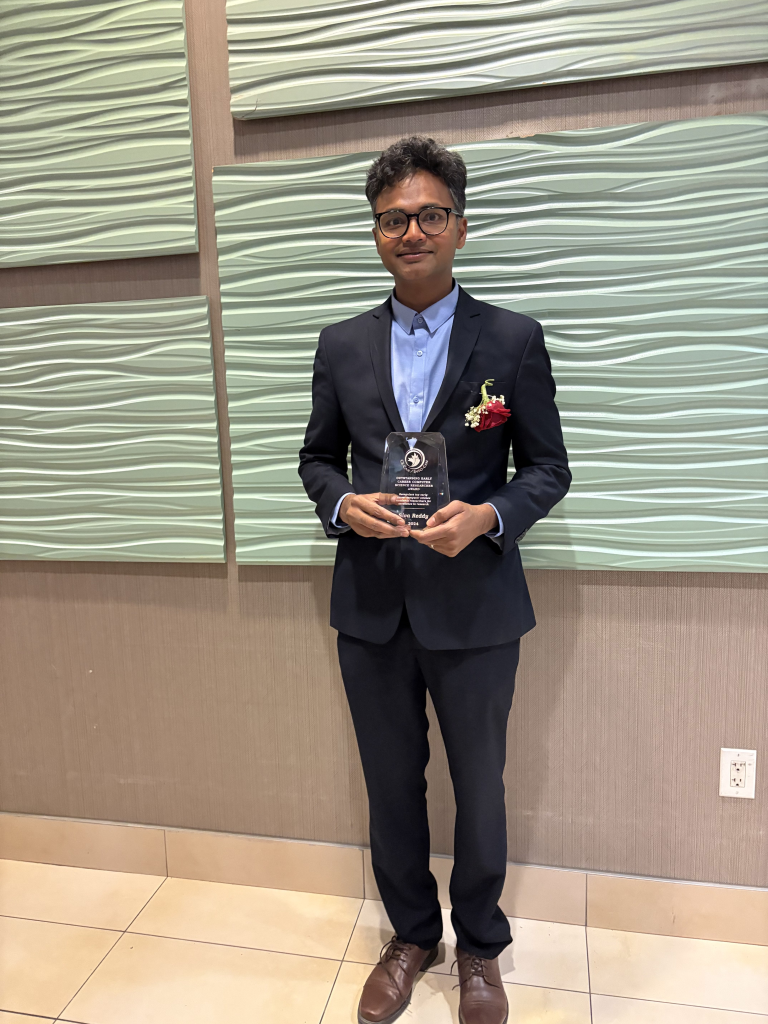
CS-Can Outstanding Early Career Computer Science Researcher award to Siva Reddy

Congratulations to Siva Reddy who received a CS-Can Outstanding Early Career Computer Science Researcher award!
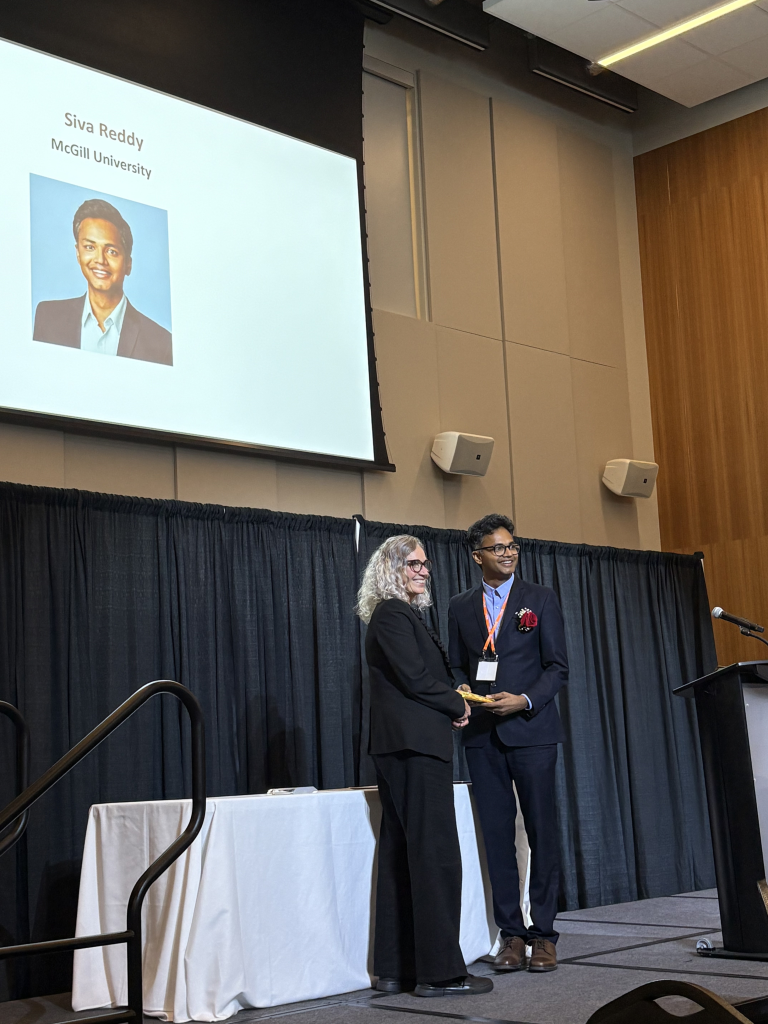
CS-Can is Canada’s national organization for advancing computer science research and education. This Early Career award recognizes CS faculty members at Canadian universities who, within 10 years of receiving their PhD, have made significant contributions in their academic careers, particularly to research.

Here is the statement that was read out at the awards ceremony:

Prof. Siva Reddy passionately delves into the intersection of computer science (Natural Language Processing and Machine Learning) and linguistics, investigating the intricate relationship between computational models of language and human language. His research is driven by four key themes: (i) empowering computational systems to represent language as efficiently as humans, (ii) constructing systems that closely emulate human-human interactions, (iii) harnessing AI for social good by ensuring computational systems avoid reproducing societal biases and stereotypes, and (iv) pioneering the development of multi-modal computational systems adept at integrating information from text, speech, and vision. His prolific work is published in large quantity in the most prestigious venues and his impact on the field is growing exponentially.

More information on this year’s award winners can be found here.

P* Group, 11/25 — Irene, Jeanne, Massimo, (Alex)

Our last P* meeting for this semester will be on Tuesday, Nov 25, from 1-2 pm in room 002 and on Zoom. 

Irene, Jeanne, Massimo, and Alex (maybe) will practice presenting for their ASA presentations!

All relevant documents (presentation schedules, abstracts, papers and slides/handouts) are available on this Google Drive.

Syntax-Semantics Group, 11/25 — Dawn Lau

The Syntax-Semantics Group will be meeting on Tuesday, November 25, at 3-4pm in Room 117 of the McGill linguistics department. Online participants can join with this link: https://mcgill.zoom.us/meeting/register/bQ4IXlJxTTShVcMHOosNtQ

Dawn Lau (McGill) will be presenting “Surprisals, The Brain, and How Thematic Roles Are Processed.” Here is the abstract:

Cross-linguistically, experimental data from neurolinguistics has initially shown blindness towards the processing of agents and patients in a sentence in filler-gap verb final sentences, such as in (1) and (2):

(1) The owner forgot which customer the waiter had served.
(2) The owner forgot which waiter the customer had served.

However, offline cloze probabilities clearly show a difference between the two. In this talk, I will present a re-analysis of this data using Surprisal Theory (Hale, 2001). Surprisal Theory has shown good correlation with both ERP N400 readings and other processing phenomenon such as garden path sentences, and has been increasingly used as a psycholinguistics model. I will also discuss what this implies for our current theoretical models of thematic roles with respect to this data.

MCQLL, 11/24 — Alessio Tosolini

Our next MCQLL meeting will take place Nov 24th at 2pm in room 002. Alessio’s talk is titled Prominence strengthening in Todos Santos Mam.

MCQLL, 11/17 — Massimo Lipari

This week’s MCQLL talk will take place Nov 17th at 2pm in room 002. Massimo will present his work, titled: Apparent vocal tract length vs /s/ acoustics in a large multilingual corpus.

P* Group, 11/18 — Jeanne Brown

Our next presentation will be on Tuesday, Nov 18, from 1-2 pm in room 002 and on Zoom. 

Jeanne will present her thesis ideas in sociophonetics.

All relevant documents (presentation schedules, abstracts, papers and slides/handouts) are available on this Google Drive.

Monthly MULL, 11/20 @ U de M

The Montreal Underdocumented Languages Linguistics Lab (MULL-Lab) is meeting Thursday, November 20 at 4PM in Pavillon Lionel-Groulx (3150 Jean Brillant St) room C-9019 of the Université de Montréal (great chance to use the new REM line!). We will have three presentations, followed by a social hour. 

Talks include:

  • Nominal licensing in Lutuv: a Case study — Hannah Katinsky (McGill)
  • Reflexives and reciprocals in Chuj  — Julien Labonté (Université de Montréal)
  • Katsi’noniowá:nen (The Flying Head) — Kahentawaks Tiewishaw (Revital Software)

IMPORTANT : For a chance to play a Kanien’kéha language learning game, bring your laptop!

The event is open to all linguists across Montreal! If you’d like to join the mailing list, please email willie.myers@mail.mcgill.ca.

Syntax-Semantics Group, 11/11 — George Bennett

The Syntax-Semantics Group will be meeting on Tuesday, November 11, at 3-4pm in Room 117 of the McGill linguistics department. Online participants can join with this link: https://mcgill.zoom.us/meeting/register/bQ4IXlJxTTShVcMHOosNtQ

George Bennett (McGill) will be presenting “Argument structure of emission verbs in Scandinavian.” Here is the abstract:

In this talk, I present some early-stage data and thoughts on verbs of emission (e.g., rain, snow, gush, flicker) in Scandinavian. I center the discussion on a couple of argument alternations in which the substance noun is the grammatical subject or introduced by the preposition “av” (in expletive subject constructions) that takes on the equivalent functions of the English by-phrase (introducing external arguments in passives) and of-phrase (the all-purpose DP-internal linker). I explore both options and discuss their implications: Either emission verb structures license substance-noun by-phrases with active voice (e.g., “it rains by a warm rain”), or they cannot take substance-nouns as internal arguments, requiring prepositional licensing (e.g., “it rains of a warm rain”). Either way, the behaviour of these verbs is not characteristic of unaccusative or unergative verbs, suggesting they might be something else.